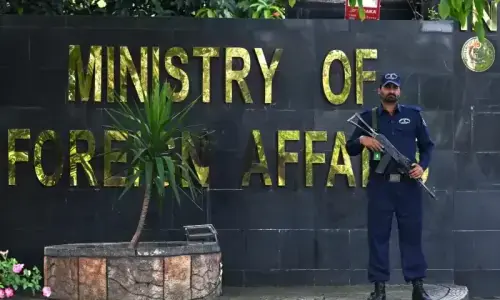
THE Federal Investigation Agency recently busted what it describes as an alleged network involved in fake apostille stickers and official stamps, booking 22 suspects, including six officials of the Ministry of Foreign Affairs. The investigation will establish what happened and who was responsible. But there is a larger question that should concern all of us: why does obtaining a perfectly legitimate government service become so difficult that an ecosystem of agents and middlemen can flourish around it?
Anatol Lieven offered an uncomfortable explanation more than a decade ago in Pakistan: A Hard Country. Writing about Pakistan’s bureaucracy, he observed that “The bureaucracy acts as an agency of distributing patronage rather than good government”. He was making a broader point than simply accusing officials of corruption: formal institutions themselves can be shaped by patronage, personal relationships and competing interests.
The result is a paradox. The machinery of the state can be weak and dysfunctional, yet the networks around it can make the system remarkably resilient. Those same networks, however, can make the state harder for ordinary citizens to navigate. Lieven’s observation remains relevant because the problem citizens encounter today is not simply corruption. It is the growing difficulty of dealing with the state itself.
Getting a document attested from the foreign affairs ministry can mean hours in queues, repeated visits, uncertainty about requirements and the possibility of another objection from another official. When a legitimate administrative process becomes sufficiently difficult, the middleman finds an opportunity. And when the middleman becomes almost indispensable, corruption has fertile ground in which to grow.
The answer to every administrative failure cannot be another layer of control.
I know something about this from personal experience. Last year, I wrote to the foreign minister, Ishaq Dar, about the immense difficulties young Pakistanis were facing in getting documents attested. I asked for a system that would allow citizens to obtain a legitimate government service with dignity, without spending hours standing in the heat or cold. The response was brief: the authorities were aware of the problem and had already taken steps to improve the situation.
Unfortunately, my experience since then suggests that the problem has not disappeared.
My own family has encountered similar problems elsewhere in the system. Two adult daughters were once stopped at Lahore airport and questioned for almost two hours before an international trip, including being asked why they were travelling without a male relative.
On another occasion, the Foreign Office refused to attest an affidavit prepared for a university abroad because, I was told, both parents had to consent even though the applicant was an adult. The embassy of the country concerned eventually accepted the affidavit without the Foreign Office attestation.
More recently, a newborn’s passport became another bureaucratic journey. The father, living abroad, had to fly back to Pakistan because his presence was considered necessary before the passport could be issued. Even after the passport was processed, the parents were asked to have their identity documents attested by a Grade-17 officer before collection. These are not extraordinary demands in a country facing war or famine. They concern passports, affidavits and identity documents.
And that is the point. A state does not become stronger by making every legitimate interaction with it more difficult. Nor does every additional verification, signature, attestation or layer of authority necessarily make a system more secure. Sometimes it simply creates another point at which a citizen becomes dependent on an official’s discretion.
We often discuss corruption as though it begins with the person offering money at a counter. But the deeper problem can begin much earlier, when the legitimate route becomes so cumbersome that people start looking for another route.
Lieven’s insight was that the problem is not simply individual dishonesty. It is the way the system itself can operate through patronage, personal relationships and discretion. As he put it, people with even limited power can use it to “turn to their advantage the workings of the law and the bureaucracy”.
That is why the answer to every administrative failure cannot be another layer of control. A new verification may be introduced to prevent fraud. Another signature may be demanded in the name of security. Another attestation may be added to ensure authenticity. Each may appear reasonable in isolation. Together, they can create a maze in which the honest citizen becomes increasingly dependent on the very system that is supposed to serve them.
Pakistan is a poor country. Its citizens understand that. They do not expect government offices to provide five-star service. But they can reasonably expect something much more basic: when the law gives them a legitimate right, the state should make it reasonably easy to exercise that right. This is the argument I had made in my letter to the foreign minister a year back.
A birth certificate should not become an odyssey. A passport should not require unnecessary suspicion. A document attestation should not require an agent. A citizen should not have to prove, at every counter, that he or she is innocent of some imagined wrongdoing.
The government does not need another committee to discover this. It needs to look at the citizen’s journey through the system and ask a simple question: how many of these steps are actually necessary?
Because corruption is not created only at the counter. Sometimes the conditions for it are created much earlier, by a system that makes a simple, legitimate service unnecessarily difficult.
The writer is a former journalist and strategic communication and public health professional, with experience across Asia, Africa and the Middle East.
Published in Dawn, September 30th, 2026