UNITED NATIONS: The UN General Assembly on Tuesday overwhelmingly voted in favor of a resolution demanding an immediate humanitarian ceasefire in Gaza.
The resolution also demands the prompt and unconditional release of all prisoners involved in the ongoing unrest. This marks the second such a resolution was adopted by the General Assembly, unlike the UN Security Council where resolutions calling for a ceasefire were vetoed.
The resolution, moved in the General Assembly on Tuesday, was cosponsored by more than 100 countries and passed with a large majority of 153 votes. The vote reflects an increase in support for the ceasefire’s demand.
A similar measure in late October drew a nod from 121 countries. The United States and Israel were among the 10 countries that voted against it on Tuesday, while 23 abstained.
Austria, Czech Republic, Guatemala, Liberia, Micronesia, Nauru, Papua New Guinea, and Paraguay also voted against.
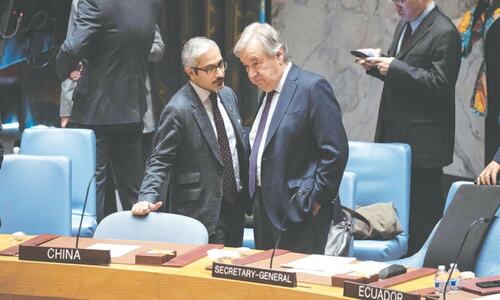
Pakistani envoy says Israel’s goal is to erase entire idea of Palestine
US allies Britain — which had abstained from voting on previous Gaza resolutions at the General Assembly and UN Security Council as well — and Germany were among the 23 countries that abstained.
Prominent US allies — including Canada, Australia and Japan, which had previously abstained — were among the more than 30 countries that switched their position.
Multiple Asian countries that had abstained in Oct, including India and South Korea, voted in favor of the latest resolution. Muslim and Arab nations, which have denounced the Israeli offensive in Gaza, also supported it.
The adoption underscores global urgency to address the humanitarian crisis in Gaza and the collective call for a cessation of hostilities.
The resolution reflects the international community’s commitment to finding a peaceful resolution to the ongoing conflict, emphasising the paramount importance of human lives and safety in the region.
Earlier, the United States and Austria moved amendments seeking to name Hamas as the party that triggered the unrest by launching rockets in Israel, but both were rejected. Both failed to secure the 2/3rd majority required for adoption.
“The United States is increasingly isolated on Israel, with other governments responding to a shift in public sentiment on the conflict as the death toll in Gaza rises past 18,400 people, including thousands of children,” The Washington Post noted in its report on the UN vote.
The report also pointed out that the shifting public opinion also forced US President Joe Biden to publicly acknowledge that “the indiscriminate bombing that takes place” was beginning to cost Israel support around the world.
“We have one singular priority – only one – to save lives,” said General Assembly President Dennis Francis while opening the emergency session. He warned that civilians in Gaza “have nowhere safe to shelter from the fighting and aerial bombardment.”
Palestinian Ambassador to the UN Riyad Mansour hailed the vote as “historic,” noting that the resolution “does not ‘call for’ or ‘urges’ — it demands. And “we will not rest until we see compliance of Israel with this demand,” he added.
US Ambassador to the UN Linda Thomas-Greenfield said that Washington “agrees that the humanitarian situation in Gaza is dire…and that civilians must be protected with international humanitarian law.”
But she warned that “a ceasefire right now would be temporary at best, and dangerous at worst.” The ceasefire, she added, would be “Dangerous to Israelis, who would be subject to relentless attacks, and also dangerous to Palestinians who deserve the chance to build a better future for themselves free from a group that hides behind innocent civilians.”
Munir Akram, Pakistan’s UN ambassador, explaining his country’s position on the larger Palestinian issue. “This is a war against the Palestinian people”, he said.
“Israel’s goal is to erase not only a people but the entire idea of Palestine. It’s a carbon copy of the massive campaigns of racial slaughter by other settler colonial regimes in history.”
UNGA resolutions are not legally binding on nations, but do carry immense moral weight, representing the collective resolve of the international community on a matter of grave importance.
Published in Dawn, December 14th, 2023