Saffron flags hoisted on mosque, church in India amid unrest


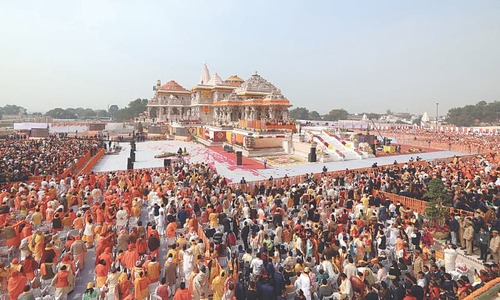
NEW DELHI: A mosque and a church were assaulted as Hindutva mobs staged victory marches in BJP-ruled states a day after Prime Minister Narendra Modi inaugurated a controversial temple in Ayodhya.
A group of Hindu activists unfurled saffron flags in a mosque in Agra in Uttar Pradesh amid reports of a similar attack on a church in Madhya Pradesh.
In BJP-ruled Assam on Tuesday police booked Rahul Gandhi for “wanton acts of violence”, as the political confrontation between the Congress leader and Chief Minister Himanta Biswa Sarma escalated on the 10th day of east-to-west peace march. Mr Gandhi asserted that he does not get “intimidated” by such tactics.
“With reference to wanton acts of violence, provocation, damage to public property and assault on police personnel today by Congress members, an FIR has been registered against Rahul Gandhi, K.C. Venugopal, Kanhaiya Kumar and other individuals…,” the chief minister posted on X.
Communal clashes reported in several states
Mr Sarma said the “Naxalite” behaviour of the crowd was against the “Assamese culture” in the peaceful state.
In Agra, police arrested 11 persons for hoisting Hindu saffron flags atop and inside a Mughal-era mosque. The incident took place during a ‘shobha yatra’ taken out by right-wing activists soon after Mr Modi completed the consecration ceremony of the Ram Mandir in Ayodhya at the site where the Babri Masjid stood till December 6, 1992.
According to the FIR lodged at Tajganj police station in Agra, the caretaker of the Diwan ji Ki Begum Shahi Masjid in Billochpura alleged that around 1,000-1,500 persons carrying “lathis and sticks” forcibly barged into the mosque at around 3:30pm in January 22. The men also raised religious slogans and threatened those inside the mosque, alleged the caretaker. They were “unabashedly using undignified language for the other religion”, the FIR said quoting Zahiruddin, who was not available for further comments.
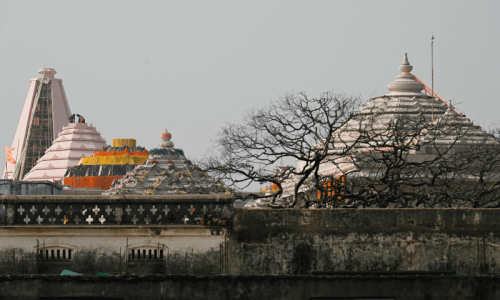
The rauza and mosque are dedicated to Diwanji Begum, daughter of Khwaja Ghiasuddin Qaziwani and mother of Mumtaz Mahal, said the ASI. According to The Wire, the police official said the year of construction of the mosque was recorded in a Persian inscription as 1677, representing the Shah Jahani style of architecture.
Violence also broke out in parts of Maharashtra, Gujarat and Madhya Pradesh, reports said. Any kind of dissent was met with police action.
Screenings of Ram ke Naam, a documentary film on rightwing Hindu fanaticism by Anand Patwardhan, were disrupted in Hyderabad and Kerala. Some educational institutions even issued pre-emptive restrictions on their students. Students were beaten up; posters were torn in some places.
The Wire gave a list of incidents that occurred both in the run up to and on the day of the consecration ceremony. Communal clashes were also reported in Nagpur, Mira Road, Panvel and Pune in Maharashtra.
At the Film and Television Institute of India (FTII), Pune, the students’ union organised a peaceful protest under the banner ‘Remembering Babri’ on Tuesday.
Even as more students were joining the protest, a group of men sporting saffron scarves entered the campus, and set the banner on fire. A few among them filmed the attack. In the video, accessed by The Wire, the men could be seen chanting “Jai Shri Ram” and one of the miscreants could be seen saying, “We would destroy not one but a thousand more Babris (mosques)”.
On the outskirts of Mumbai, three separate incidents – two on Mira Road and one in Panvel – were reported.
Right-wing activists planted a saffron flag atop the holy cross on a church in Madhya Pradesh.
The Wire reported how the crowd cheered triumphantly as four young men climbed atop a small church and planted a saffron flag on the holy cross, a sacred religious symbol for Christians. The flag had ‘Jai Shri Ram’ and an image of Lord Hanuman printed on it.
This was one of the four incidents that occurred on the eve of the ceremony in Ayodhya, in Jhabua district. Similar saffron flag-hoisting incidents were reported in villages namely Dabtalai, Matasula, Uberao and Dhamaninathu, all situated in the Ranapur tehsil of Jhabua, on the western fringes of Madhya Pradesh, with the majority of the residents being tribal.
Published in Dawn, January 25th, 2024