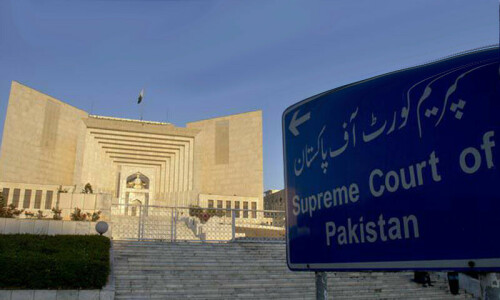
ISLAMABAD: The Supreme Court has sought the assistance of religious institutions, including the Council of Islamic Ideology (CII), with a directive to furnish statements on its Feb 6 judgement in the Mubarak Ahmad Sani case.
Headed by Chief Justice of Pakistan (CJP) Qazi Faez Isa, a three-judge Supreme Court bench on Monday took up the Punjab government’s review petition against the verdict which overturned the conviction, by the Lahore High Court, of Mr Sani on charges of distributing proscribed literature.
The court also issued notices to Jamia Darul Uloom Karachi, Jamia Imdadia Faisalabad, Jamia Naeemia Karachi, Jamia Muhammadia Ghousia Bhera, Jamia Salafia Faisalabad, Jamiatul Multazir Lahore, Jamia Urwat-ul-Wusqa Lahore, Quran Academy Lahore and Al Mawrid Lahore.
The court advised other organisations or individuals desiring to give their opinions, to do so in writing before the next hearing.
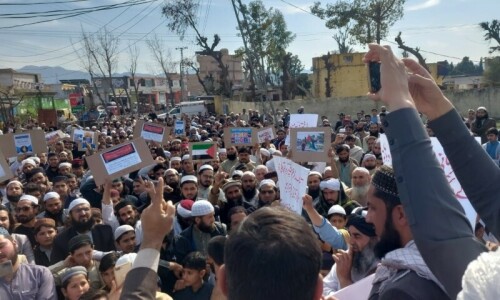
The court ordered registration of an application moved on behalf of the Jamaat-i-Islami (JI) seeking to become a party in the case on a request by counsel Shaukat Aziz Siddiqui. The counsel said JI believed that the court did not receive “proper assistance” before reaching a conclusion in the matter.
The court was seized with a review petition filed by the Punjab government with a plea that an observation in the Feb 6 verdict needed modification because religious freedom, as envisaged in Article 20 of the constitution, was not absolute and subject to law, morality and public order. Article 20 ensures freedom to profess religion and to manage religious institutions.
In the judgement, the SC had stressed that the Holy Quran does not speak of compulsion in religion and the Constitution had laid down freedom to practise religion as a fundamental right.
The provincial government argued that it was aggrieved by the judgement since the conclusions were based on an “erroneous assumption of the material facts”.
Mr Sani, the respondent, was named as an accused in an FIR registered in Chiniot on Dec 6, 2022, under Sections 295-B and 298-C of the Pakistan Penal Code (PPC), as well as Section 9(1A) of the Punjab Holy Quran (Printing and Recording) Act 2011. He faced charges of distributing literature that could “hurt religious sentiments”.
On June 24 last year, the trial court framed charges against Mr Sani under Sections 295-B and 298-C of PPC and Section 9(1A) of the act.
The accused filed an application for deletion of the charge before the trial court, but it was dismissed on Sept 25.
Mr Sani challenged the order before the Lahore High Court, but the LHC also dismissed his plea on Oct 16.
He challenged the high court’s order through a criminal petition before the Supreme Court, which was allowed on Feb 6.
Published in Dawn, February 27th, 2024