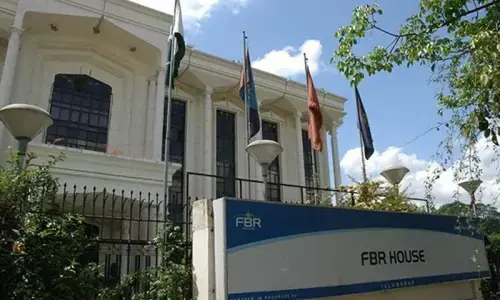
NOT too long ago, it was reported that the Pakistan Customs Group’s association had moved a resolution seeking proof of the government’s allegations of corruption and inefficiency against certain tax officers. It threatened to take legal action against Prime Minister Shehbaz Sharif for purging the Federal Board of Revenue (FBR) of these officers. A majority of votes for the resolution ensured its passage within 24 hours. This was a swift reaction to the removal of 25 officers — 11 of them belonging to Customs and 14 were from Inland Revenue. Apparently, the PM’s actions were rooted in adverse reports from the intelligence agencies regarding these officers.
Sooner or later, a court will issue a stay order on these removals and various delaying tactics will ensure that these officers retire in due course of time. If guilty, they would neither be stripped of their privileges nor penalised for the plunder that they might have indulged in during their career. This is the playbook for all unscrupulous elements in powerful quarters. Issue a swift and aggressive rejoinder, let the matter cool down, emerge from media scrutiny and take the exit. This happens with the connivance of comrades in the service, who are sometimes accomplices to the crime and at others too timid to complain about wrongdoing.
The association, instead of just threatening Mr Sharif with legal action, could have gone a step further and revealed the assets of the ‘honest’ officers for public scrutiny. I am sure investigative journalists can do the honours — as they do in their scrutiny of political persons. We all know about political sacred cows, but some civil servants do not lag too far behind; and are themselves often considered ‘untouchable’ in this sense.
The association took 24 hours to come to the defence of the officers who have been removed from their posts. But on how many occasions has the same association issued press releases calling for departmental action against corrupt officers who bring disrepute to their organisation? Does it mean that no officer in Customs or FBR has been involved in any corrupt practices? I leave the answer to this question to the common sense of the readers.
There is no official law — just the official who is the law.
There have been very few whistle-blowers among the ranks of officers and their fate has not been very encouraging. Either they are tagged as problematic and never get a good posting, or are themselves accused of wrongdoing just to erase the credibility of their accusations.
The various trainings during the career of civil servants are meant to promote camaraderie and coordination within the law and the ambit of Pakistan’s civil service. However, these often end up creating a mafia of sorts, whose members ensure they protect each other whenever some adverse action is taken against one of them, even if justified. Loyalty to one’s batch-mate takes precedence over loyalty to the state.
It is impossible to obtain proof of kickbacks, because the latter are not received directly in bank accounts, but more often in cash. On top of that, those who give these kickbacks are not in a position to become whistle-blowers. If they make any such move, they turn into persona non grata for these services. No businessman wants Customs or FBR officials to scrutinise his day-to-day dealings, because the law is complicated and he can be dragged into long legal battles.
Under such circumstances, there is no official law — just the official who is the law. The proverbial ‘software update’ (a term used for a change in the stance of someone accusing powerful quarters of wrongdoing) is just round the corner if a mere mortal tries to be a whistle-blower. So, for a businessman, it makes perfect sense to make less profit by paying these elements their cut, rather than making no profit at all by being put out of business.
Forgive me for being harsh but, in protecting each other, civil servants often disregard the law. The only time they go against each other is when one gang is pitted against the other. For example, the Pakistan Administrative Service might find fault with the Police Service of Pakistan, or the Secretariat Group officers might accuse PAS officers of being promoted undeservingly — but nothing more. It is a fact that civil services personnel tend to protect their own no matter how unscrupulous or corrupt these elements may be, rather than serving a public denied its fundamental rights.
Many would say, not incorrectly, that there are two ways of getting rich in this country: giving or taking a bribe. Businesses that wish to grow, give bribes; government functionaries receive it. Whether anyone likes it or not, that is the law that rules.
The writer is a former civil servant.
Published in Dawn, May 21st, 2024