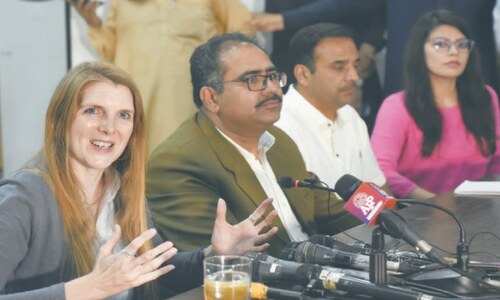
ISLAMABAD: The Supreme Court has taken exception to remarks made by British High Commissioner Jane Marriott during a public event, in which she underlined the “importance of democracy, elections and need for open societies”.
On the instructions of Chief Justice of Pakistan (CJP) Qazi Faez Isa, the court’s registrar, Jazeela Aslam, wrote a letter to Ms Marriott on May 3.
The letter notes that the British government expressed the need for open societies and democracy and offered criticism on the Supreme Court’s decision, through the high commissioner’s speech at the Asma Jehangir Conference on April 27, expressing the hope that “reciprocity would presumably be acceptable”.
The contents of the letter suggest that exception was taken to the Jan 13 Supreme Court judgement which ruled against allotting the election symbol, bat, to the PTI.
SC registrar’s letter explains verdict on PTI election symbol, calls diplomat’s criticism of decision ‘unjustified’
The registrar’s letter explained that the Elections Act of 2017 required democracy within political parties through holding of intra-party elections in order to discourage “autocracy, or even dictatorship”, within them.
“The Supreme Court reiterated what the law stipulated. Therefore the criticism with regard to this decision, with utmost respect, was unjustified,” Jazeela Aslam, the registrar, wrote in her letter.
In her speech, Ms Marriott had emphasised that democracy should never be taken for granted and that people should avoid being complacent. She then cited Foreign Secretary David Cameron’s remarks that the large turnout was in spite of concerns about fairness and inclusivity in the elections.
“Not all political parties were permitted to contest the elections, legal process was used to prevent some political parties from participation and the use of recognised party symbol,” the high commissioner had said in her speech at the conference.
The registrar explained that elections in Pakistan were required to be held within 90 days of completion of the tenure of the National Assembly and the four provincial legislatures, but were delayed because the president and the ECP were at odds about who had had the powers to announce the date.
But the matter was finally resolved in just 12 days by the Supreme Court and general elections were held throughout Pakistan on Feb 8, the letter said.
It was gratifying that the Excellency had repeatedly stressed the importance of ‘open societies’ which she stated were necessary for vibrant democracies. “You will be pleased to learn that the Supreme Court has recognized the right to information and vigorously applied it to itself,” the letter said.
“It is worthy to mention that it was upon the current CJP’s assumption of office that cases of public importance began to be broadcast live for the first time in Pakistan’s history,” the letter said.
Lessons from history
“Let us embrace the truth, which sets us free,” the letter said, adding that persisting with “violent, undemocratic mistakes” of the past condemns present and future generations to enduring cycles of violence.
It then recalled two historic events; the 1953 overthrow of Mohammad Mossadegh’s government in Iran to access oil, and the unilateral enforcement of the Balfour declaration by the British government.
In the case of the former, Ms Aslam noted, should the truth not be revealed even after seven decades of cover-up.
“Will this not prove therapeutic for the perpetrator and the victim? Will it not engender trust, possibly friendship and peace?”
Referring to the creation of Israel, the letter referred to the “Jewish Zionist aspirations” which the British government ceded to when it wrote to an individual, its own citizen, conveying its decision to establish a settler-colonial state.
“This decision was not voted upon by the people of the area who were impacted by it, nor even by her own. The British government and not Parliament, unilaterally decided it. The Balfour Declaration became the foundation on which an ethnic state was established,” the letter said.
Copies of the registrar’s letter have been sent to Lord Robert John Reed, the President of the Supreme Court of the United Kingdom, and Baroness Sue Lascelles Carr, Lady Chief Justice of England and Wales.
Published in Dawn, May 30th, 2024