GILGIT: From glaciers to towering snow-capped peaks and the local architecture in between, the scenic vistas that greet you as you enter Gilgit-Baltistan are unparalleled in their grandeur.
However, as any tourist who has visited the region knows, the menace of littering mars the natural beauty of this region. As better infrastructure has brought more and more tourists into this Himalayan region, with it has come the demon of litter and rubbish.
In the dusty and smoky cities, overflowing rubbish heaps and errant plastic bags floating in the wind have somehow become normalised, with urban dwellers perhaps becoming desensitised to the foul stench and sight of litter in their immediate environs.
Seeing empty plastic bottles littering the banks of rivers and nullahs, or observing the remnants and refuse of an expedition being left by the wayside atop a majestic glacier, are sights that are enough to invoke pangs of guilt within any visitor with a conscience.
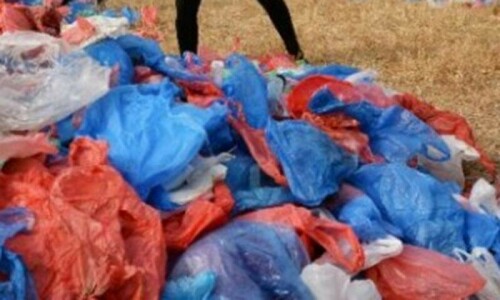
But now, thanks to efforts of local authorities and help from a corporate sponsor — Nestle Pakistan — the Gilgit-Baltistan Waste Management Company (GBWMC) has made strides in combating the scourge of plastic pollution following the installation of plastic bailing machines.
The bulking yet simple apparatus acts as a press to shrink plastic bottles and other refuse from their otherwise ungainly shapes into compressed bales of plastic that can easily be sent for recycling.
These compressing and baling machines have been installed in Gilgit, Hunza and Skardu so far. GBWMC workers collect around one to two tonnes of plastic waste on a daily basis, which is then brought to the baling machines and compressed.
On average, 60 to 70 tonnes of plastic waste is compressed and sent for recycling each month, while segregated waste is sent to cities in Punjab because the required recycling facilities are not available in Gilgit-Baltistan.
Explaining the significance of the baling machines, District Monitoring Officer GBWMC Kacho Muhammad Imran Khan told Dawn that all work, i.e. collecting, segregating and compressing the waste, was done manually since it was still at a limited scale.
However, if the initiative is scaled up, it would be mechanised to make it even more efficient and enhance their capacity to process waste, he said.
If such plastic waste remains where it is dumped, e.g. next to tourist attractions such as lakes and glaciers, it would take millions of years to decompose and would prove extremely harmful to the local ecology, contaminating everything from the soil to the water.
A plastic waste collection point has also been established by the government in the city of Gilgit, where people are encouraged to submit plastic bottles and other waste in exchange for nominal sums of money.
Published in Dawn, June 24th, 2024