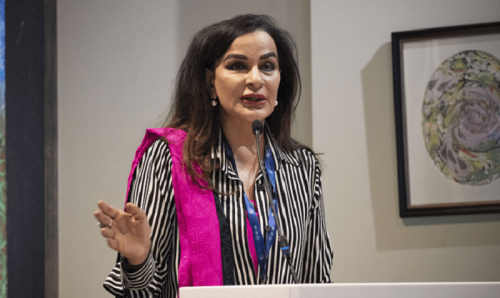
ISLAMABAD: Senate Standing Committee on Climate Change chairperson Sherry Rehman on Tuesday highlighted Pakistan’s multifaceted climate challenges and called for a coordinated and shared strategy among environmental institutions.
“Pakistan’s exposure to climate stress is so high that resilience must be redefined across the board. It can’t just be about infrastructure; it has to be local and people-centric,” she said while presiding over the committee meeting.
Senator Rehman underscored the importance of a resilient approach to counter the adverse impacts of climate change in Pakistan.
The parliamentary committee was informed that Sindh and eastern parts of Balochistan were set to receive a fresh spell of monsoon rain on July 8-9, while upper and central parts of the country, including Rawalpindi and Islamabad, would experience rainfall from July 10 to 15.
“The National Disaster Management Authority and the Pakistan Meteorological Department have predicted above-normal rainfall,” Sherry Rehman said, adding that the committee is keen to understand the measures for risk reduction and predictability of the monsoon across the country.
“From the available reports, it appears that the eye of the storm will likely be Punjab,” Ms Rehman said.
She also pointed out the lack of updated equipment in disaster management departments due to insufficient funding.
“After the 2022 floods, all funds were re-allocated to flood-affected areas because of the shortage. The capacity of PDMA and other regional institutions must be increased to prevent disasters,” she added.
National Disaster Management Authority (NDMA) Chairman Lt Gen Inam Haider Malik briefed the Senate body about the expected weather patterns, stating that heavy, moderate, and scattered rainfall was anticipated in various regions, including Punjab, Sindh, Balochistan, Khyber Pakhtunkhwa (KP), Azad Jammu and Kashmir (AJK) and Gilgit-Baltistan (GB) between July and August. This rainfall could lead to urban flooding, flash floods, and river tributary overflows.
“Rainfall may also trigger landslides and mudslides in upper Khyber Pakhtunkhwa, Gilgit-Baltistan, Galiyat, Murree, and Azad Jammu and Kashmir,” warned Lt Gen Malik.
He also provided details on the preparations and risk reduction strategies for the upcoming monsoon season, emphasising a proactive approach to disaster mitigation. The monsoon system was expected to enter Pakistan from India, with Khyber Pakhtunkhwa and Punjab likely to be more affected by heavy rainfall by the end of July and in August.
Published in Dawn, July 10th, 2024