SpaceX set to launch billionaire’s private crew on breakthrough spacewalk mission


A crew of four private astronauts on Tuesday were in the final stages of preparation for a risky SpaceX mission to attempt the first-ever private spacewalk using the company’s new spacesuits and a redesigned spacecraft.
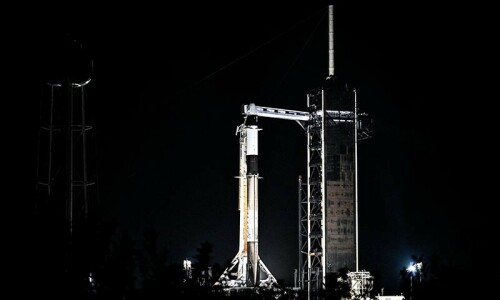
A billionaire entrepreneur, a retired military fighter pilot, and two SpaceX employees are poised to launch at 3:38 am from NASA’s Kennedy Space Center in Florida aboard SpaceX’s Crew Dragon capsule, the spacecraft’s fifth — and riskiest — private space mission so far.
An attempt to launch last month was postponed hours before liftoff over a small helium leak in ground equipment on SpaceX’s launchpad. SpaceX fixed the leak, but the company’s Falcon 9 was then grounded by US regulators over a booster recovery failure during an unrelated mission, further delaying the Polaris launch.
Permitted to resume Falcon 9 flights, the Polaris mission is now set for a pre-dawn launch Tuesday, but with only a 40 per cent chance of favorable weather, according to US Space Force launch weather modeling. SpaceX has other launch opportunities Tuesday at 5:23am and 7:09am.
“Crew safety is absolutely paramount and this mission carries more risk than usual, as it will be the furthest humans have traveled from Earth since Apollo and the first commercial spacewalk!,” Elon Musk, SpaceX’s CEO, wrote about the mission last month on his social media site X.
Only highly trained, well-funded government astronauts have done spacewalks in the past. There have been roughly 270 on the International Space Station (ISS) since its creation in 2000, and 16 by Chinese astronauts on Beijing’s Tiangong space station.
The SpaceX mission, called Polaris Dawn, will last about five days in an oval-shaped orbit that passes as close to Earth as 190 km (118 miles) and as far as 1,400 km (870 miles), the farthest any humans will have traveled since the end of the United States’ Apollo moon program in 1972.
The spacewalk is planned for the mission’s third day at 700 km in altitude and will last around 20 minutes. SpaceX’s Crew Dragon craft will slowly depressurize its entire cabin — it has no airlock like the ISS — and all four astronauts will rely on their slimmed-down, SpaceX-built spacesuits for oxygen.
The first US spacewalk was in 1965, aboard a Gemini capsule, and used a similar procedure to the one planned for Polaris Dawn: the capsule was depressurised, the hatch opened, and a spacesuited astronaut ventured outside on a tether.
Jared Isaacman, 41, a pilot and the billionaire founder of electronic payment company Shift4, is bankrolling the Polaris mission, as he did for his Inspiration4 flight with SpaceX in 2021. He has declined to say how much he is paying for the missions, but they are likely to cost hundreds of millions of dollars.
Joining him is mission pilot Scott Poteet, 50, a retired US Air Force lieutenant colonel; and SpaceX employees Sarah Gillis, 30, and Anna Menon, 38, both senior engineers at the company.
For the spacewalk, Isaacman and Gillis will exit the spacecraft tethered by an oxygen line while Poteet and Menon stay in the cabin.
The mission is the first in Isaacman’s private Polaris program that includes a follow-on Crew Dragon mission in the future, followed by a flight on SpaceX’s Starship, a giant rocket the company has spent billions of dollars developing as a flagship moon and Mars vehicle.
The four-person crew are effectively test subjects for an array of scientific experiments that will aim to shed light on how cosmic radiation and the vacuum of space affect the human body, adding to decades of studies on astronauts living aboard the ISS.
Since the retirement of the Space Shuttle in 2011, NASA has relied heavily on the company and its Crew Dragon, which has flown nine astronaut missions to and from the ISS for the agency as the only US crew-grade vehicle in operation.
The company has previously flown four private missions: Isaacman’s Inspiration4, and three private astronaut flights arranged by Houston-based mission broker Axiom Space.
Boeing is struggling to develop a similar spacecraft, Starliner, that could rival Crew Dragon. But Starliner’s latest NASA test mission that began in June — its first time flying a crew — left its astronauts on the ISS last week because of issues with its propulsion system.