Israel’s gradual escalation against Iran: a tried & tested tactic


ISLAMABAD: Israel’s airstrikes on Iran constitute a calculated escalation, extending beyond a single military operation and foreshadowing additional rounds of conflict.
Striking 20 Iranian military sites from Iraqi airspace, Israel directly claimed responsibility for the attack on Iran for the first time, indicating its confidence bolstered by support from the West in general and the United States in particular and a clear intent to confront.
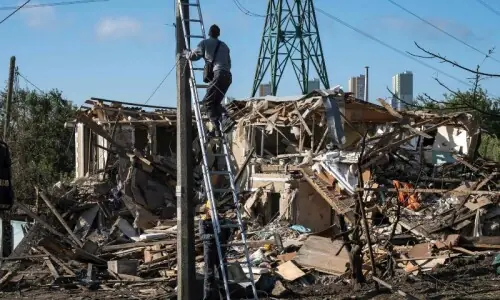
The strikes targeted Iran’s radar, air defence, and missile facilities, primarily aiming to weaken Iran’s defensive capabilities, limiting its ability to retaliate or respond to future confrontations.
The Iranian Armed Forces’ General Staff acknowledged the strikes, downplaying their impact, and described the damage as “limited and low-impact.” Iran’s air defence, which lost four personnel, was credited with mitigating the attacks’ full impact, launched from nearly 100km away from Iranian borders.
While Iranian authorities typically avoid acknowledging enemy attacks or resulting damage, the Iranian media also downplayed this event.
However, Iran’s Supreme Leader, Ayatollah Ali Khamenei, in his first remarks since the Oct. 26 strikes, cautioned against either exaggerating or dismissing the attacks.
He stated, “It would be wrong for us to say that it was nothing and did not matter,” while criticising Israel for overstating the strikes’ impact. Khamenei’s emphasis on not ignoring the attack signaled a stance against normalising such provocations by downplaying them.
Israel’s approach: gradual escalation
This operation reflected Israel’s traditional strategy of gradual escalation — a calculated approach where a party incrementally intensifies its actions to achieve deterrent balance. Sudden escalation can pose risks to an instigator’s interests, but gradual steps allow for maintaining strategic control.
Israel has used this approach in the past with Hezbollah, initially launching limited operations that gradually crossed red lines, as it waited for Western military aid for augmenting its arsenals before initiating full-scale hostilities.
The immediate goal of this strategy seems effective, as Iran, despite initially signaling readiness to retaliate, has refrained from an immediate retaliation. This restraint benefits Israel, which remains heavily engaged on multiple fronts, particularly in Gaza and South Lebanon, where it is facing resistance from Hezbollah fighters and has been suffering regular losses.
International response
The international response to these tensions has been lacklustre. While the US supports Israel’s actions, which raises complex questions about Washington’s role as a peace broker, the UK and France have urged Iran to show restraint, while implicitly backing Israel.
Despite this, Iran may find diplomatic leverage in the situation, as it hinted at potential de-escalation under conditions prioritizing ceasefire efforts in Gaza and Lebanon, while reserving the right to retaliate if its demands are unmet.
In a statement, the Iranian Armed Forces indicated, “Iran, while reserving the right to respond legally and legitimately at the appropriate time, insists on establishing a lasting ceasefire in Gaza and Lebanon.”
Although the US would prefer to prevent Israel from becoming embroiled in a broader conflict, escalating tensions in Lebanon might prompt Washington to take Iran’s concerns more seriously and encourage ceasefire efforts. However, under any situation it is unlikely that the US focus on diminishing the axis of resistance in the Middle East will change. The restoration of relations between Iran and Saudi Arabia, brokered by China, has added a new level of complexity in the Middle Eastern dynamics, as Saudi Arabia, which not long ago was considering signing Abraham Accords with Israel, has not only condemned the attacks, but is also planning joint war drills with Iran. This shift signals China’s growing influence in the region, challenging US interests.
Additionally, Russia’s supply of SU-400 air defence systems to Iran has discouraged Israeli F-35s from entering Iranian airspace, forcing them to launch air-to-surface missiles from Iraqi airspace instead.
Published in Dawn, October 28th, 2024