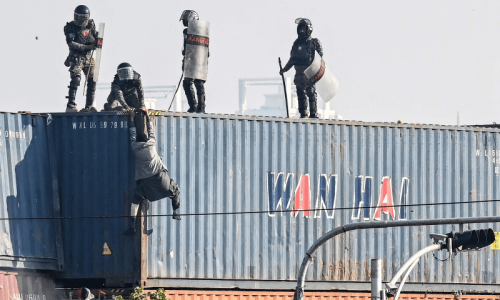
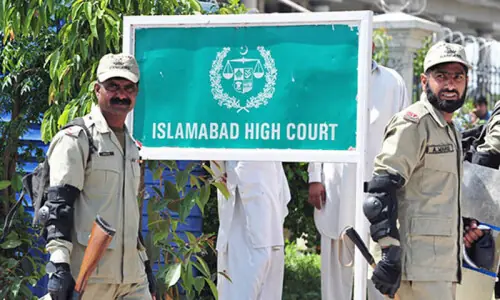
WHILE the state may have succeeded in beating back PTI supporters from the capital’s red zone last week, the battle of narratives between both sides with regard to the deaths that reportedly occurred during the confrontation continues.
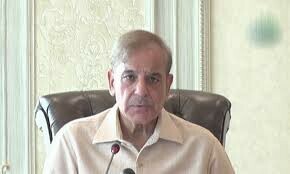
The PML-N-led government insists no PTI supporters were killed by law enforcers, while the latter remains adamant that its activists were targeted by the state. The federal information minister told a press conference that no PTI worker was killed during the clashes, while accusing the Imran Khan-led party of spreading fake images and videos on social media to support its narrative. Moreover, the government says four security personnel died in the violence and around 190 were injured while confronting protesters.
While figures quoted by PTI leaders and supporters initially varied greatly, the party now says that 12 supporters died in the melee, and that the state is hiding the truth. It is also a fact that the administration is worried about the PTI narrative on social media, which is why it has formed a joint task force to trace those behind the “massive malicious campaign”.
In the midst of these claims and counter-claims, instead of focusing all its energies on hunting down the PTI’s keyboard warriors, the state would be better off supporting a transparent investigation into the reported deaths. While countering fake news is essential, it is more important to ascertain if there were actual deaths during the confrontation. The reported deaths of law enforcers must also be probed.
Therefore, a judicial commission acceptable to both sides can be formed to conduct an impartial inquiry into the matter. This would put to rest rumours and ensure that justice is served.
It is also important for the government as well as the opposition to agree to some rules of engagement regarding future protests. The right to protest is part and parcel of the democratic process, but some SOPs need to be hammered out and agreed to by all parties so that future demonstrations do not end in bloodshed.
Also, the prime minister has suggested the creation of a special anti-riot squad. If this plan goes ahead, the state needs to give clear guidelines regarding where and how this squad is to be deployed, while its core mandate should be handling volatile situations through non-lethal means. The government’s efforts to project the PTI’s protest campaign as ‘anti-state’ also needs a rethink. As stated above, all parties and groups have a constitutional right to peacefully assemble.
Criticism of the government, therefore, cannot automatically be treated as criticism of the state, as this gives licence to the administration to brand all opposition parties and critical groups as ‘anti-national’. A clear demarcation is required between anti-government protests, and anti-state activities.
Published in Dawn, December 3rd, 2024