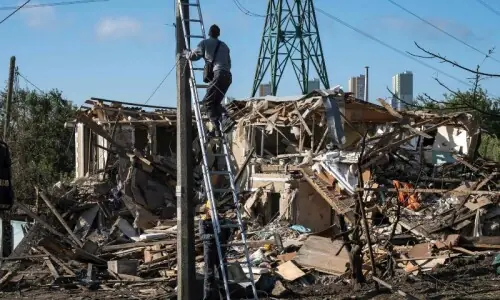
AL NAYRAB: At least seven civilians, including a woman and a child, were killed on Thursday when unexploded munitions ignited at a house in northwestern Syria, a war monitor said.
The Syrian Observatory for Human Rights reported the deadly blast a day after another organisation said two-thirds of Syrians risked being killed or wounded by unexploded ordnance. “Seven civilians, including a woman and a child, were killed when leftover munitions stored inside a house” in Idlib province exploded, the Observatory said.
A correspondent saw civil defence teams retrieving bodies from the rubble of the destroyed house in Al-Nayrab. Civil defence worker Mohammed Ibrahim said they had been called to the scene of an “explosion of unknown provenance”.
“When teams headed to the site, they found unexploded ordnance,” he added. The Observatory said the owner of the house was a scrap dealer who collected unexploded ordnance for its metal content. Residents said that the owner had stored the munitions adjacent to the house.
Journalists were not allowed to approach the site for fear of further explosions. Non-governmental organisation Humanity and Inclusion had warned on Wednesday of the dangers posed by unexploded munitions left over from the devastating civil war that erupted in 2011.
It said experts estimated that between 100,000 and 300,000 of the roughly one million munitions used during the war had never detonated.
‘Absolute disaster’
It’s “an absolute disaster”, the group’s Syria programme director Danila Zizi said, adding that “more than 15 million people (are) at risk” out of a resident population of some 23 million.
As hundreds of thousands of Syrians return to their homes after Islamist-led rebels finally toppled Bashar al-Assad in December, “urgent action is needed to mitigate the risk of accident”, the group said.
According to UN figures, more than one million people have returned to their homes since Assad fled, 280,000 of them from abroad.
Zizi said that the crude barrel bombs used in large numbers by Assad’s air force during the war had a “higher rate of failing” than other munitions. She said that mines planted by the militant Islamic State group during their slow retreat in the late 2010s meant there were also “lots of booby traps that have never been really marked or mapped”.
In January alone, 125 unexploded ordnance accidents were recorded in which at least 85 people were killed and 152 injured,
Published in Dawn, February 21st, 2025