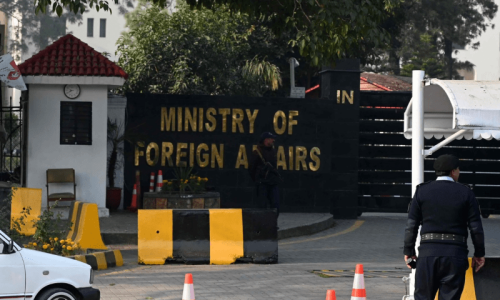
AS Pakistan and India count their casualties, tend to the wounded and grieve the fallen, the leaderships of the two nations, as well as their people, must ask themselves whether perennial conflict is in their individual interests.
The military confrontations between the two nations last week provided just a small glimpse into the destruction that can be unleashed on both sides of the border in the event of an all-out war. The American president, who brokered a ceasefire between the two, has remarked that his administration helped prevent a nuclear exchange.
If hostilities had reached that point, the leaderships of India and Pakistan would have failed their most fundamental duty: to prevent catastrophe. As nuclear nations, both countries have a duty to wield their powers with utmost responsibility and immense restraint. It is in the strategic interest of both nations to avoid all-out war, and ceasefires are not concessions but necessary steps to prevent irreparable damage.
The Indian government’s decision to escalate hostilities by striking mainland Pakistan was dangerously provocative and must be seen as a grave miscalculation. Matters were not helped by the gleeful cheerleading for the ensuing violence by the media on both sides of the border. The pressure to attack and counter-attack kept growing, till, it seems, both countries were ready to launch full-scale hostilities against each other. In retrospect, the region narrowly avoided calamity: we are now being told we were on the brink of a nuclear war. Citizens of both countries need to understand what that would have entailed.
Should nuclear weapons ever be used, the consequences would be catastrophic beyond imagination. For all those who survive, the fallout will guarantee a life of unimaginable misery. Within hours, a region with millennia of shared history, culture and civilisation would be reduced to rubble. Major cities on both sides would be annihilated. The bombs would spare no one: men and women, young and old.
Over the following week, tens of millions more will die from their injuries or radiation sickness. Disease and starvation on a cataclysmic scale will follow as the subcontinent’s health and food supply infrastructure collapses. The effects will not be confined to this region alone: the bombs and the ensuing fires will release dangerous and radioactive pollutants in the air, which will circulate around the world, triggering a ‘nuclear winter’ and decimating agricultural output. Billions more would be at risk of famine.
The issues between the two countries seem manageable in comparison. Perhaps it is wiser and simpler to work on them than to risk the end of the world. International diplomacy may have halted escalation in this instance, but durable peace can only come from the political will and wisdom of leaders in both India and Pakistan. That responsibility cannot be outsourced.
Published in Dawn, May 14th, 2025