SC CB examines scope of Article 200 in judges’ transfer


• Justice Afghan warns permanent transfers may render JCP redundant
• Justice Mazhar questions impact of fresh oath on judge’s seniority
• Counsel argues Constitution doesn’t allow permanent transfers
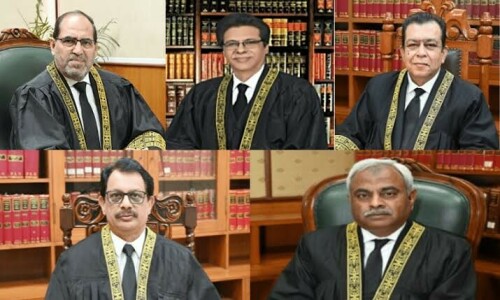
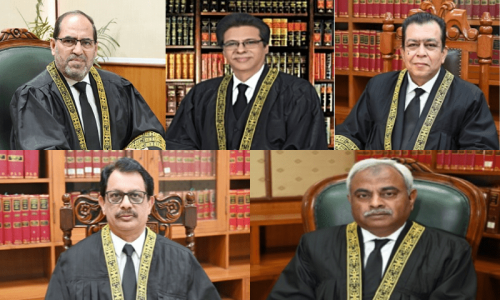
ISLAMABAD: Justice Naeem Akhtar Afghan, a member of the five-judge Constitutional Bench (CB) of the Supreme Court, on Friday expressed concern that the Judicial Commission of Pakistan (JCP), which functions under Article 175A of the Constitution, could become redundant if judges are permanently transferred from one high court to another by invoking Article 200.
Referring to the transfer of three judges to the Islamabad High Court (IHC) from the Lahore High Court (LHC), Balochistan High Court (BHC) and Sindh High Court (SHC), Justice Afghan wondered how a judge could dispense justice without taking a fresh oath, given that judges are required to take an oath to administer justice without fear or favour under the law and Constitution.
The observation came during the hearing of a joint petition filed by five IHC judges — Justices Mohsin Akhtar Kayani, Tariq Mehmood Jahangiri, Babar Sattar, Sardar Ejaz Ishaq Khan and Saman Rafat Imtiaz.
The petition pleaded that the three transferred judges should not be treated as IHC judges until they take a fresh oath under Article 194, read with Schedule III of the Constitution.
However, Justice Muhammad Ali Mazhar, who headed the five-judge Constitutional Bench, questioned whether requiring a fresh oath upon transfer would render the original oath — taken upon elevation to the parent high court — invalid, which would consequently impact the judge’s seniority.
Senior counsel Faisal Siddiqi, representing former presidents of the Islamabad High Court Bar Association, argued that Article 200 of the Constitution was meant to enable temporary transfers of judges from one high court to another, not permanent ones.
He stressed that such transfers should be time-bound and highlighted the need to consider legislative intent in interpreting Article 200. He also noted that the original provision did not include the phrase “consent of the judge,” which was added later through amendment, and insisted that only the JCP should appoint judges to high courts.
Justice Afghan remarked that these questions were now surfacing due to unforeseen developments, and noted that Article 200 existed even before the establishment of the IHC under the Islamabad High Court Act, 2010, which was enacted on August 2, 2010, leading to the court’s establishment on April 22, 2010.
Justice Salahuddin Panhwar, however, pointed out that the Constitution does not specify that such transfers should be for a limited duration.
Justice Mazhar cited the Indian model, where a unified seniority list of all high court judges exists and where judges must relinquish their post if they do not consent to a transfer. In contrast, in Pakistan, Justice Ahmed Sheikh continued to serve as a judge of the SHC despite refusing elevation as an ad hoc judge of the Supreme Court.
Justice Mazhar also highlighted a discrepancy in the counsel’s argument, noting that if a judge takes a fresh oath upon every transfer, it would affect his seniority and potentially end his career trajectory, as he would become the most junior judge at the new court.
To substantiate his point, the judge referred to the case of Acting Chief Justice of IHC Sardar Sarfraz Dogar, who would become the most junior judge upon returning to the LHC and taking a fresh oath — despite having been 16th in seniority before the transfer to the IHC.
The hearing will resume on Monday.
Published in Dawn, May 24th, 2025