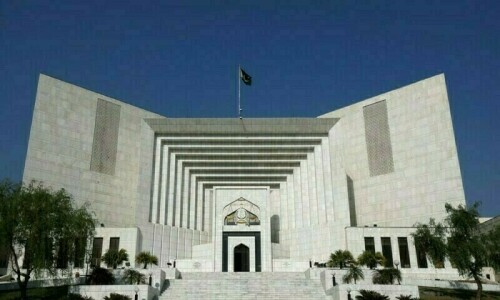
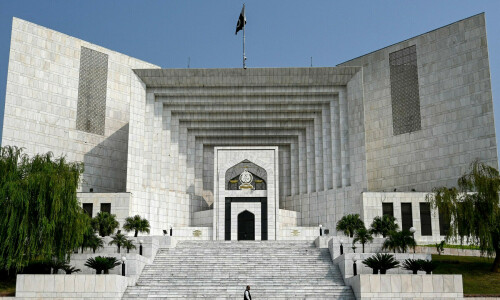
Supreme Court rift: Justices Shah, Akhtar say judicial process undermined in 26th Amendment controversy


A letter, penned by Supreme Court Justices Syed Mansoor Ali Shah and Munib Akhtar, has exposed another deepening rift within Pakistan’s apex court, this time over Chief Justice Yahya Afridi’s failure to implement what the two judges argue was a legally binding decision by a Supreme Court Committee to hear challenges to the controversial 26th Constitutional Amendment before a Full Court.
The letter, which has surfaced amid a brewing controversy, reveals a clash over judicial independence, transparency, and the handling of one of Pakistan’s most politically charged constitutional issues: the 26th Amendment, which alters judicial authority and tenure, and has been a lightning rod for debate, with opposition parties and legal experts questioning its impact on the judiciary’s autonomy.
The letter states that on October 31, 2024, Justices Shah and Akhtar, members of the Supreme Court Committee formed under the Practice and Procedure Act, 2023, had pushed for a Full Court hearing to address petitions challenging the amendment’s validity. They argued that only a collective adjudication by all judges could restore public faith in the institution, which was seen at the time to have been battered by political pressures.
However, CJP Afridi, citing informal, private consultations with other judges, insisted that the cases should be assigned to a Constitutional Bench — a body created under the very amendment that was under scrutiny.
In a dramatic turn, the two justices said they had convened a formal Practice and Procedures Committee meeting the same day, deciding by majority to schedule the petitions for November 4, 2024, before a Full Court. The decision was never complied with by the Registrar of the Supreme Court, even after a subsequent letter was issued to them.
The CJP, who skipped the meeting, later issued notes justifying his refusal to comply. The two notes from the CJP, recently uploaded to the Supreme Court’s website, suggest that he had declined to implement the committee’s decision because such a move could have dampened the “much-needed spirit of collegiality” among the judges and “further expose the court to public scrutiny”.
However, Justices Shah and Akhtar complain that these notes were never shared with the members of the Committee, but presented at a Judicial Commission meeting – a move that the justices believe was legally inappropriate. The Registrar’s failure to act on the Committee’s directive further escalated tensions, leaving the petitions unresolved nearly ten months later. The judges also stated that they had thoroughly examined both notes authored by the CJP — now available in the public domain — and concluded that they neither provided a valid reason nor legal justification for non-compliance with the Practice and Procedures Committee’s “legally binding” decision on October 31, 2024.
The letter also raises questions over the sudden public disclosure of the Committee’s minutes of the October 31 meeting on the Supreme Court website despite a prior decision to restrict their circulation. The letter suggests this may be linked to the upcoming resumption of Constitutional Benches in September 2025. The judges have also highlighted amendments to the Practice and Procedure Act that removed Justice Akhtar from the Committee, labelling it as an attempt to centralise power with the CJP.
The controversy comes at a critical juncture for Pakistan’s judiciary, already grappling with accusations of political interference. The 26th Amendment, passed in 2024, has previously been criticised by PTI and legal circles as an effort to block Justice Shah, the senior-most judge, from becoming CJP.
In light of the CJP’s explanations being uploaded, the two justices demanded that their letter, too, be placed on the Supreme Court website to ensure transparency, promising to release it publicly if ignored.
“The challenges to the 26th Amendment continue to remain pending, and a golden opportunity to decide them at the earliest instance before the institution as a whole — i.e., the full court as it then stood — has been lost, perhaps irretrievably.
“This was the most appropriate forum (in terms of composition) to resolve the fundamental constitutional issues in a manner that would not only satisfy the dictates of law and justice but also ensure a judicial decision whose legitimacy could not be questioned,” the letter regrets.