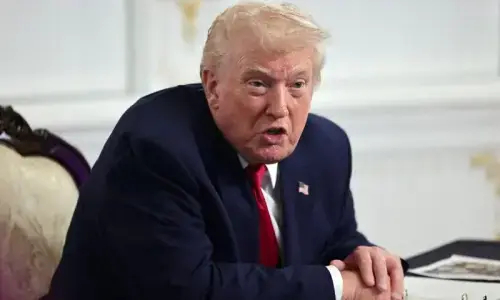
WHEN Donald Trump says that his power is restrained only by “my own morality”, he is not just boasting, he is making a case for a philosophy that governs his rule.
In a recent interview with The New York Times, the US president argued that international law, treaties and institutions apply only when he decides they do. The argument has surface appeal. Rules are slow, alliances awkward and multilateral bodies frustrating. Why should a superpower bind itself when it can act?
Yet this view misunderstands the purpose of law. Rules between states were not created because leaders are naturally wise or restrained. They were created because history shows us what happens when power goes unchecked. Mr Trump’s remarks suggest that these limits are optional. If international law aligns with US interests, it applies. If it does not, it can be ignored, redefined or brushed aside.
Mr Trump’s worldview is straightforward. Strength decides outcomes; law follows later, if at all. This thinking was visible across the interview. Greenland was discussed as something to be owned rather than respected as an ally’s territory. Venezuela was treated as a problem to be solved by military action. Throughout the discussion, the underlying view appeared to be that strength gives permission. Except, there exists this contradiction: rivals, he insists, must not use the same logic. China should not act on Taiwan; Russia should not redraw borders. The objections lack principle. Whereas American power is exceptional, making the country’s actions acceptable, others’ is destabilising. Such logic cannot hold. Rules applying only to the weak vanish. Other states will take notes and copy the example. Treaties become temporary and morality becomes whatever the powerful declare it to be.
The same pattern appears within the US. Congress is respected until it resists. Courts matter “under certain circumstances”. Emergency powers stretch when challenged. A parallel can be seen closer to home.
Pakistan’s own history shows what happens when power claims to stand above law. Whether under military rulers or hybrid arrangements, decisions have often been justified in the name of stability, security or higher national interest.
Yet this reliance on personal discretion has weakened institutions, blurred accountability and left citizens unsure where authority truly lies. When leaders decide that their judgement is a better safeguard than rules, uncertainty, not order, follows. A system that rests on personal morality is a fragile one. Leaders change. Tempers flare. Incentives shift. What remains is the example set.
If law is treated as optional by those who wrote it, it will soon be ignored by those who did not. The danger is not that America will act forcefully. It always has. The danger is that it will stop explaining why force should be limited at all.
Published in Dawn, January 12th, 2026