Speakers link folk literature to climate survival
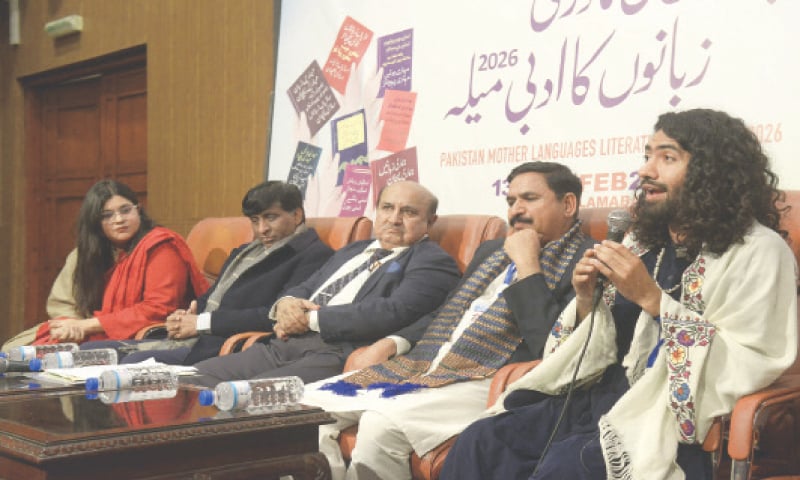

ISLAMABAD: “When the river dries, our cultural imagination dries with it,” remarked a speaker during a session on folk literature and climate change that turned into an urgent call to reconnect language and land for survival on the third day of the Pakistan Mother Languages Festival 2026, held at the Pakistan National Council of the Arts (PNCA) on Sunday.
The talk, moderated by Ghina Mehr, brought together poets, academics, activists and journalists who argued that the climate crisis is not merely an environmental or technical issue, but a cultural and civilisational one.
“In our folk tradition, the river, soil and land are not just a backdrop, they are the main protagonists,” Mehr said at the outset, questioning whether climate change was merely “a matter of files” or fundamentally “a matter of culture and land”.
Opening the discussion, climate activist and performer Abuzar Madhu invoked a verse of Guru Nanak, translated as, “Air is the guru (teacher), water is the father, and the great earth is the mother”. The verse, he said, reflects a deep ecological and spiritual connection that underlines the sacred relationship between humans and nature embedded in regional traditions.
Panel calls for cultural revival, indigenous languages to confront environmental crisis
Tracing stories of the Ravi from mythology to folklore, Mr Madhu said rivers were once understood as living beings shaping identity. “We have lived with the river for thousands of years. Our stories narrate its bends, its moods, its journey from mountains to the sea,” he said.
Yet, he warned that as rivers shrink and change course, collective imagination also suffers. He criticised what he described as a “colonial lens” through which rivers and land are studied. “If language survives, the story survives,” he stressed.
Sindhi poet Javed Soz admitted that while folk poetry has historically resisted political oppression, its engagement with climate change remains uneven. “In Sindh, poetry has always taken the side of the river and the land,” he said.
He pointed out that biodiversity, once central to folk poetry, is gradually fading from contemporary literary discourse. While poetry reacts to disasters, he said, it must develop sustained engagement with climate realities.
Mr Soz emphasised that literature has a pivotal role in driving change, adding that new modes of communication, especially social media, must be used to carry climate narratives to younger audiences.
Seraiki scholar Dr Ismatullah Shah linked climate change directly to lived realities in riverine and desert regions. Sharing verses and proverbs from Seraiki folklore, he illustrated how seasonal cycles and migratory birds are woven into lullabies and rituals.
“Our entire folk literature is connected to the environment. Rivers do not die, but civilisations do,” he remarked.
Dr Ismail Kumbhar, an academic focusing on water resources and sustainable development, described climate change as not only environmental but existential. He explained the difference between weather and climate, noting that climate refers to long-term shifts in patterns that directly affect agriculture, food security and social stability.
From seed germination to harvest cycles, farming depends on precise temperature and water conditions, he said. Floods in 2010 and 2022 had already exposed vulnerabilities, and further temperature rise could devastate the country’s agro-ecological base.
“When fertility declines, when drainage fails, when certified seed is unavailable, it is not only crops that suffer but human life and social systems suffer,” he stressed.
Journalist and researcher Aliza Khalid called for a fundamental shift in reporting and cautioned against commodifying indigenous knowledge. “Nature can exist without humans. We must decide whether we want to exist within nature’s system,” she said.
Concluding the discussion, speakers collectively stressed that climate change must be addressed not only through policy measures but through cultural revival by restoring indigenous languages and strengthening folk traditions.
Published in Dawn, February 16th, 2026