
DESCRIBED as the most consequential election in its recent history, Bangladesh last week voted to provide the Bangladesh Nationalist Party (BNP) an overwhelming majority. The polls have ended the political uncertainty that had gripped the South Asian nation since the overthrow of the previous regime by a student-led uprising in 2024. Yet the challenges for the new government are daunting.
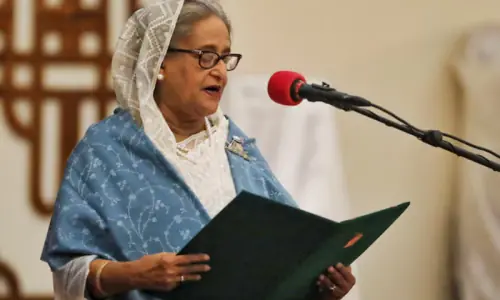
While the BNP’s victory was not in doubt, the landslide win came as a surprise given the forecast of tough competition from the challengers. The large turnout of voters indicated the people’s faith in the restoration of democracy after a long period of authoritarian rule. The previous Awami League government, led by Hasina Wajid, had ruled the country for 15 years before being ousted in 2024. The party was barred from contesting the elections.
Bangladeshis voted for a nationalist and secular party that had ruled the country several times in the past and had suffered persecution under Hasina Wajid’s regime. The defeat of the Jamaat-i-Islami-led 11-party alliance is seen as a rejection of conservative, religion-based politics. Voters also backed constitutional reforms that include a two-term limit for prime ministers, the setting up of a bicameral parliament and greater representation for women.
Post-independence, Bangladesh alternated between civilian and military rule. The country’s political landscape had been dominated by two political dynasties led by two women — Hasina Wajid and Khaleda Zia — who succeeded one another in power.
The new PM takes charge at a time when Bangladesh is at a pivotal juncture.
While Hasina Wajid, who had been sentenced to death by a special Bangladesh tribunal for crimes against humanity, is now living in exile in India, Khaleda Zia, who led the BNP and also served as prime minister twice, passed away in December last year after being released from detention. Her party is now led by her son Tarique Rahman.
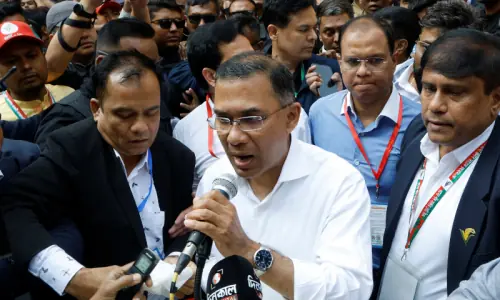
Rahman, who had returned to Bangladesh from self-exile in England only recently after the last government’s ouster in 2024, has taken oath as the country’s new prime minister. He had fled the country in 2008 after being charged with corruption by a military-backed caretaker dispensation. Rahman, who had never held a government position before, led the party in the elections on a nationalist and reform agenda.
He takes charge at a time when Bangladesh is yet to recover from the political unrest that led to the overthrow of a civilian dictatorship. The Gen-Z revolt has changed the political landscape of Bangladesh. A major challenge for the new government is to improve governance and purge state institutions of political influence. The constitutional reform package that has been overwhelmingly approved by the voters may help address some of these issues.
Despite a long period of authoritarian rule and political unrest, Bangladesh has done well in economic development. From a basket case, Bangladesh went on to become one of the fastest-growing economies in the region. In social indicators, too, it’s ahead of most South Asian countries.
But over the last few years, economic growth has slowed down substantially and higher inflation has affected people’s lives. The readymade garment sector, which is critical to the country’s exports, faces a crisis. The slowing down of the economy has also exacerbated unemployment, particularly among the young generation.
Economic revival presents the biggest challenge to the new government. The prime minister has promised to diversify the economy and focus on social welfare programmes to ease the effects of high inflation. With a huge youth bulge the unemployment problem will be a major test for the government.
Additionally, although the new government has a comfortable two-thirds majority in parliament it needs to put in much effort to restore political stability. Despite being barred from contesting the elections, the Awami League, which ruled the country for a large part of its history, remains a major political force that could create problems for the government.
Hasina Wajid seems to be actively guiding her supporters from exile in India. She has rejected the elections as a farce. It doesn’t look like the Indian government will agree to Bangladesh’s demand to extradite her. The issue remains a sticking point in relations between the two countries.
Bordered on three sides by India, Bangladesh had developed very close ties with New Delhi under the Awami League government. In fact, critics had accused the former prime minister of turning the country into a client state of India. It was a great setback for New Delhi when Hasina Wajid was ousted from power.
The Narendra Modi government has not only refused to extradite her but apparently has not stopped her political activities either. Relations between the two countries had hit a new low over the past few months, with Dhaka accusing New Delhi of providing protection to fugitives allegedly involved in murder.
Although the new government has indicated a reset in relations with India, there are some serious problems that are hard to resolve — among them water-sharing disputes and border incidents. The anti-India sentiment among large segments of the population has led to calls for a foreign policy that is independent of New Delhi.
Over the past few years, Bangladesh had managed a delicate balancing act with India and its other neighbour China, which has emerged as its biggest trading partner. China has also invested heavily in infrastructure projects. Worsening relations with India have led Bangladesh to lean more on China.
Meanwhile, relations between Bangladesh and Pakistan improved dramatically under the caretaker administration after the fall of the Hasina Wajid government. The two countries have not only established close economic and trade ties but have also been cooperating in defence areas. They have also restarted a direct air service.
In his first press conference after the elections, the new prime minister has stressed regional cooperation and building relations with all countries keeping the national interest of Bangladesh foremost. He has also talked about reviving Saarc, which had virtually become defunct because of India-Pakistan tensions. A politically stable Bangladesh under a democratic government is a good omen for regional peace.
The writer is an author and journalist.
Published in Dawn, February 18th, 2026