WASHINGTON: The White House has acknowledged that the Donald Trump administration is deliberately avoiding categorical statements on Iran, as doing so could limit the president’s flexibility in a fast-evolving security environment.
Speaking to reporters on Wednesday, White House Press Secretary Karoline Leavitt said deploying US ground troops into Iran is not part of the current military strategy, but declined to rule out the option entirely.
“It’s not part of the current plan, but I’m not going to remove an option for the president that is on the table,” she said.
Leavitt suggested that previous administrations had sometimes narrowed their strategic space by prematurely dismissing potential actions before fully assessing how unfolding developments might alter the situation.
The present approach, she indicated, is designed to preserve maximum latitude for decision-making.
The calibrated message reflects a broader doctrine in US national security policy: maintain ambiguity to strengthen deterrence while avoiding premature escalation. For now, officials emphasise that no ground deployment is under consideration, but the administration is keeping its options open as events evolve.
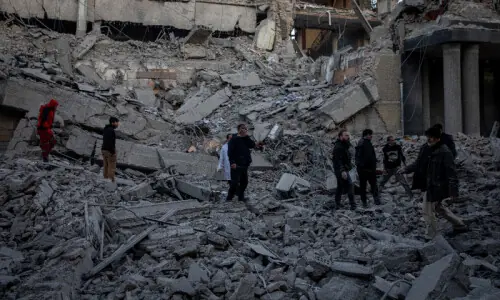
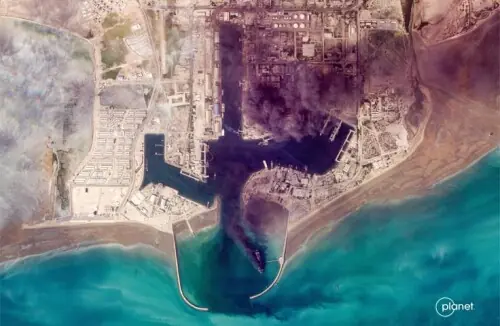
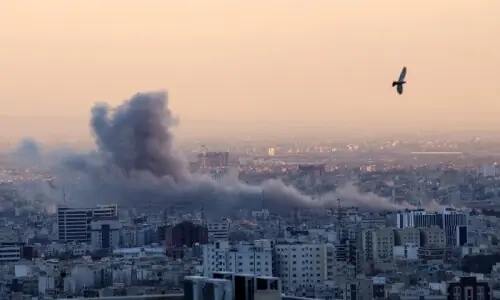
Her remarks came during the first White House briefing since the launch of “Operation Epic Fury”, a joint US–Israeli campaign of air and naval strikes against Iran that began on Feb 28. The strikes have targeted military and security infrastructure and eliminated Supreme Leader Ayatollah Ali Khamenei and several senior Iranian commanders.
Since the operation began, neither Washington nor Israel has deployed ground forces, relying instead on airpower and naval strikes. Leavitt said the campaign has four main objectives: eliminating Iran’s ballistic missile threat, destroying its naval capability, disrupting its missile and drone production infrastructure and cutting off Tehran’s pathway to a nuclear weapon.
She claimed that the United States was moving towards “complete and total control” of Iranian airspace and that nearly 2,000 targets had been struck so far.
The possibility of sending ground forces has nonetheless become a central question as the conflict intensifies. When asked about the issue earlier this week, President Donald Trump himself declined to rule it out.
“Like every president says, ‘There will be no boots on the ground’. I don’t say it,” Trump told The New York Post. “I say ‘probably don’t need them,’ [or] ‘if they were necessary’.”
At the Pentagon, Chairman of the Joint Chiefs of Staff Gen Dan Caine avoided discussing the possibility of deploying troops.
“I’m not going to comment on US boots on the ground. I think that’s a question for policymakers. And I don’t make policy, I execute policy,” he told reporters.
The growing confrontation has also triggered sharp debate in Congress, where some lawmakers fear the United States could be drawn into a prolonged war.
Senator Richard Blumenthal, a Democrat from Connecticut, said he was “more fearful than ever” after attending a classified briefing on the operation this week.
“I am more fearful than ever after this briefing that we may be putting boots on the ground and that troops from the United States may be necessary to accomplish objectives that the administration seems to have,” he told reporters.
Blumenthal said the briefing left him with unanswered questions about the administration’s long-term strategy.
“I also am no more clear on what the priorities are going to be of the administration going forward, whether it is destroying the nuclear capacity of Iran or simply the missiles or regime change or stopping terrorist activities,” he said.
Other Democrats voiced similar concerns. Senator Elizabeth Warren said the situation was “so much worse than you thought”, accusing the administration of launching the war without demonstrating an imminent threat to the United States.
Senator Chris Murphy warned that the conflict could lead to additional American casualties.
“This is as serious as it gets. This is war and peace,” Murphy said. “They told us in that room that there are going to be more Americans that are going to die.”
Some Republicans also acknowledged the possibility that ground forces could eventually be required.
Republican lawmaker James Comer said while most members of Congress hoped to avoid such a scenario, it could not be ruled out.
“If there are boots on the ground, I hope they’re not on the ground any longer than the boots on the ground were in Venezuela,” Comer told NewsNation. “But sometimes that’s unavoidable in a situation like this.”
For now, the Trump administration insists the current strategy relies on air and naval power rather than ground forces.
But by refusing to categorically rule out “boots on the ground,” officials appear determined to preserve military and diplomatic flexibility as the conflict continues to unfold.