WASHINGTON: President Donald Trump’s Friday night Truth Social post was more than political showmanship. It was the announcement of a major US military offensive, with real strategic implications.
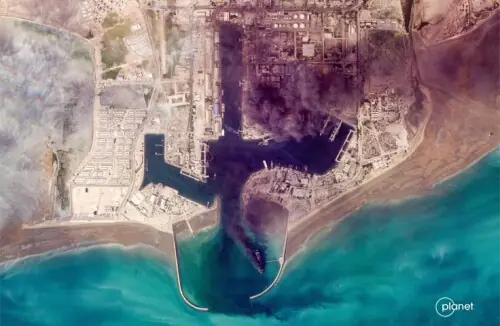
“Moments ago, at my direction, the United States Central Command executed one of the most powerful bombing raids in the History of the Middle East, and totally obliterated every MILITARY target in Iran’s crown jewel, Kharg Island,” Trump wrote — openly declaring a US-led airstrike on Iranian territory.
Kharg Island is a small coral island in the northern Strait of Hormuz off Iran’s southwestern coast. It is Iran’s most strategically vital economic asset because nearly 90 per cent of the country’s crude oil exports are loaded and shipped from its terminals.
That concentration makes Kharg both the crown jewel and, in a strategic sense, Iran’s Achilles’ heel — a single chokepoint whose disruption could severely damage Tehran’s oil-dependent economy and weaken its ability to sustain spending on military operations.
In his post, Trump stressed US military superiority and conditional restraint: “Our Weapons are the most powerful and sophisticated that the World has ever known,” adding that “for reasons of decency, I have chosen NOT to wipe out the Oil Infrastructure on the Island.”
That second phrase matters. In one sentence, he claimed restraint from hitting Iran’s economic artery; in the next, he set a clear escalation condition. He warned: “However, should Iran, or anyone else, do anything to interfere with the Free and Safe Passage of Ships through the Strait of Hormuz, I will immediately reconsider this decision.”
This line expands the scope of the threat from military targets to maritime commerce and global energy flows — the Strait of Hormuz carries roughly one-fifth of the world’s oil.
Another line in the post — “Iran has NO ability to defend anything that we want to attack — There is nothing they can do about it!” — is a stark assertion of US dominance in the air and at sea.
In the same post, he also declared: “Iran will NEVER have a nuclear weapon, nor will it have the ability to threaten the United States of America, the Middle East or, for that matter, the World!”
Trump then demanded that “Iran’s Military, and all others involved with this Terrorist Regime, would be wise to lay down their arms, and save what’s left of their country, which isn’t much!”
He further claimed: “Iran had plans of taking over the entire Middle East, and completely obliterating Israel. JUST LIKE IRAN ITSELF, THOSE PLANS ARE NOW DEAD!”
Noting the unusually harsh tone of Trump’s message, diplomatic and media observers in Washington link it to an earlier report that the United States was now sending Marines to the Middle East.
However, they point out that the Marines deployed to the region are powerful expeditionary forces, useful for reinforcing bases, securing ports, and protecting maritime lanes. By themselves, they do not constitute evidence of a ground invasion.
Observers argue that a conventional ground invasion of Iran, with its 80-plus million population and rugged terrain, would require far larger troop concentrations, sustained logistics, and broad political backing — none of which have been publicly articulated.
Describing airstrikes on Kharg Island as a serious escalation, the observers say what makes it especially consequential is the symbolic and economic message.
According to them, this indicates that the United States is willing to target not just Iran’s military infrastructure but the backbone of its hydrocarbon economy if needed. Yet even this — dramatic as it is — stops short of the occupation architecture that would make a ground assault truly imminent.
Observers note that Trump’s strike and his explicit conditional threat over Hormuz illustrate a strategy of coercive escalation — pressure without declared regime change, power projection without boots on the ground.
A conventional ground invasion, they argue, will only happen if Iran undertakes dramatic escalation, such as large-scale attacks on US forces or sustained closure of the Strait of Hormuz.
According to Axios, a reliable US news outlet, Russian President Vladimir Putin recently proposed that Russia take custody of Tehran’s enriched uranium stockpiles — potentially addressing Western fears that the material could be converted into nuclear weapons.
Trump, however, declined the offer, signaling that Washington does not want a third party controlling Iran’s nuclear material and prefers either to secure it directly or keep it closely tied to US and Israeli leverage.
The rejection also reflects that Washington is unwilling to give Russia a greater role in the Middle East and would resist any arrangement that might dilute its strategic control over the region.