Riyadh moot asks Tehran to stop attacking neighbours

• Twelve Muslim states condemn Iranian attacks across region; make no mention of US-Israeli strikes that triggered the crisis
• Official says Pakistan joined moot to create space for de-escalation, but fresh attacks shaped ‘mood against Iran’
• PM speaks to Turkiye, Jordan leaders, reiterates support for talks
ISLAMABAD: A group of 12 Arab and other Muslim countries on Thursday denounced Iranian attacks on neighbouring states as “heinous” and called for their “unconditional cessation”, urging Tehran to end support for proxy networks and avoid disrupting maritime traffic in the Strait of Hormuz.
“The ministers stressed the need for Iran to abide by implementing the Security Council Resolution 2817 (2026), which called for an immediate halt to all attacks, and unconditional cessation of any provocative acts or threats against neighbouring states,” the joint communique, issued at the end of the meeting in Riyadh, said.
It further called for “the cessation of support, financing and arming its (Iran) affiliated militias in Arab countries”, and urged Tehran “to refrain from any measures or threats aimed at closing or obstructing international navigation in the Strait of Hormuz or threatening maritime security in Bab al-Mandab”.
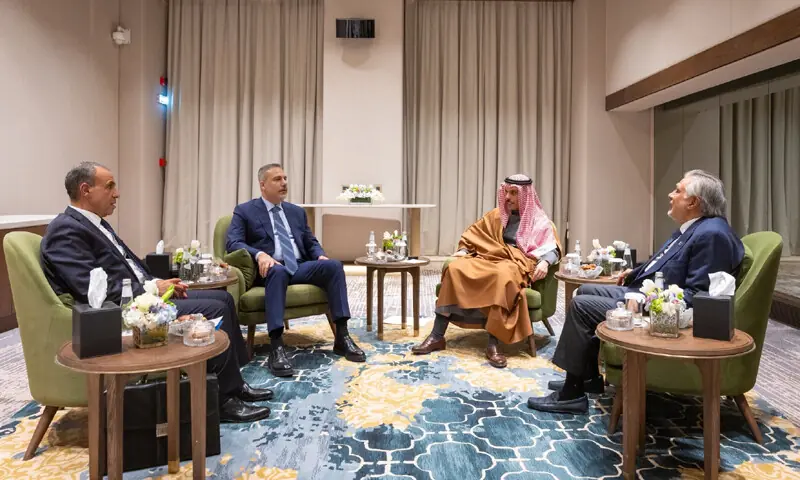
The consultative ministerial meeting, held in Riyadh, brought together foreign ministers from Azerbaijan, Bahrain, Egypt, Jordan, Kuwait, Lebanon, Pakistan, Qatar, Saudi Arabia, Syria, Turkiye and the United Arab Emirates. It was convened to address Iran’s retaliatory missile and drone strikes on Gulf Cooperation Council states, Jordan, Azerbaijan and Turkiye.
The Iran war started on Feb 28, when the US and Israel launched large-scale surprise airstrikes on Iran, killing its Supreme Leader Ayatollah Ali Khamenei and numerous senior officials. In retaliation, Iran unleashed waves of ballistic missiles and drones not only against Israel but also against US military bases and assets hosted in neighbouring countries, including Bahrain, Kuwait, Qatar, Saudi Arabia, the UAE, and Jordan.
Diplomatic sources said the gathering in Riyadh was not formally held under the umbrella of the Organisation of Islamic Cooperation, the Arab League, or the newly introduced joint version, but was instead framed as a meeting of countries directly affected by Iranian attacks. Even within that format, the absence of Oman’s foreign minister was conspicuous.
Oman has articulated a nuanced position, in contrast to the one taken by other Gulf countries. Its foreign minister Badr bin Hamad Al Busaidi struck a measured tone, condemning US and Israeli attacks on Iran while expressing regret over Iranian attacks, and warning that continued escalation would deepen regional instability.
‘Cannot be justified’
The communique went beyond a general condemnation. It described the Iranian strikes as “deliberate” attacks against residential areas and civilian infrastructure, including oil facilities, desalination plants, airports and diplomatic premises. It said such actions “could not be justified under any pretext”.
The ministers affirmed the right of affected states to self-defence under Article 51 of the UN Charter and linked the future of relations with Tehran to respect for sovereignty, non-interference and non-aggression.
In addition, the statement reaffirmed support for Lebanon’s sovereignty and backed the Lebanese government’s position on limiting weapons to the state, while also condemning Israeli actions in Lebanon. The ministers committed to continued coordination and the adoption of “necessary legitimate measures” to protect their security.
‘Most difficult diplomatic assignment’
A senior Pakistani official, speaking on condition of anonymity, described Islamabad’s participation as one of the most difficult diplomatic assignments in recent years. “We landed and had to negotiate and sit through sessions while Iranian ballistic missiles were striking Riyadh, and gas fields in the neighbouring countries were under attack, because of which it was an extremely hostile environment in the conference hall,” the official said.
The Riyadh meeting took place against an escalating backdrop, as Iran retaliated against Israel’s strike on its South Pars gas field by launching missile and drone attacks on key energy infrastructure in Riyadh on US oil depots and across the Gulf, including Qatar’s Ras Laffan LNG terminal and processing facilities, provoking intense anger among Arab leaders.
The official said Pakistan’s objective in Riyadh was to lower tensions and create space for de-escalation, but fast-moving developments on the ground shaped the mood against Iran. According to the source, Islamabad worked to soften earlier drafts of the communique that contained more expansive condemnations and sought to keep the focus on cessation of attacks and respect for sovereignty.
The official said Pakistan successfully pushed for the inclusion of language condemning Israeli actions in Lebanon and supporting Lebanese sovereignty. However, efforts to include references to the initial US-Israeli strikes that triggered the crisis were not accepted by other participants.
Critics, however, said the communique avoided addressing the origins of the conflict. They argued that it was silent on what they described as the initial US-Israeli strikes that triggered the current escalation, and did not address targeted assassinations of Iranian leaders. Senator Mushahid Hussain, who had headed the Senate’s foreign and defence committee, in particular pointed to selective criticism of Iran’s links with militias while overlooking similar conduct of other countries in other regional conflicts. They warned that such omissions could undermine the credibility of the statement.
Ahead of the meeting, Pakistan’s Foreign Office had called for restraint and emphasised the need to address the underlying causes of the conflict, while urging all sides to avoid further escalation.
PM’s phone diplomacy
Meanwhile, Prime Minister Shehbaz Sharif spoke to regional leaders. In a conversation with Turkish President Recep Tayyip Erdogan, he condemned attacks on Turkiye and other countries in the region and conveyed Pakistan’s readiness to support efforts aimed at de-escalation and dialogue.
“We urged maximum restraint and stressed the need for resolving differences through dialogue and diplomacy,” the PM said.
In a separate call with Jordan’s King Abdullah II, the PM expressed concern over the evolving situation and reiterated the need for restraint, de-escalation and a diplomatic resolution of tensions.
Published in Dawn, March 20th, 2026