Border trade with Iran carries on despite Middle East war
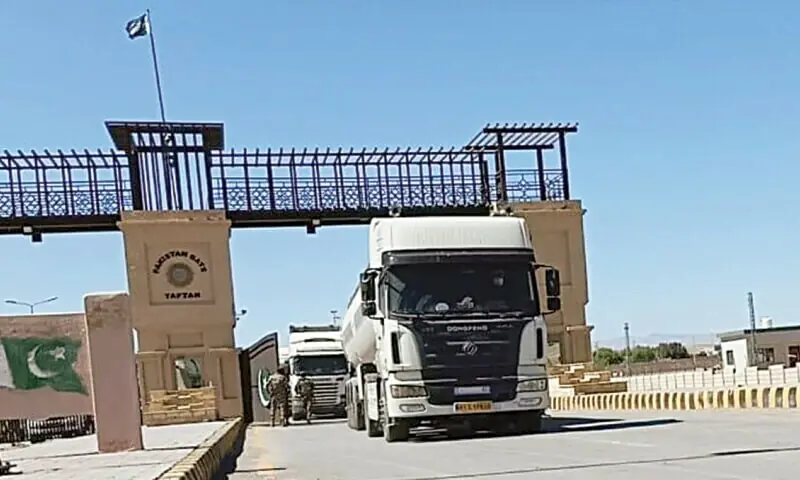

QUETTA: Border trade, including the supply of Iranian oil, LNG and electricity, has continued between Pakistan and war-torn Iran through the Makran region despite massive attacks by the US and Israel on key installations, including energy infrastructure.
“Borders with Iran at Taftan, Gabad 251 Ramdan, Mand, Panjgur and other crossing points are open, and legal trade between the two countries is continuing as usual without any restrictions,” Naveed Kalmati, chairman of the Gwadar Chamber of Commerce and Industry (GCCI), told Dawn.
Regarding petrol and diesel, he said that although the supply from Iran had decreased initially after the outbreak of hostilities between Iran and the US–Israel alliance, it had not stopped.
He added that the prices of Iranian petrol and diesel had risen even along the coastal belt because of the reduced supply. “Another reason for the increase in fuel prices is hoarding by profiteers seeking to earn illegal profits,” Mr Kalmati said.
GCCI chief says prices of Iranian fuel have risen, even along coastal belt, due to reduced supply
On LNG, the GCCI business leader said that its supply was also continuing through Gabad, Mand, Panjgur and Taftan.
“Every day, LNG-loaded bowsers are crossing into Taftan, Mand and Panjgur,” he added. However, people involved in the trade of smuggled Iranian oil insist that supplies continue uninterrupted.
“Iranian petrol and diesel are arriving by land and sea routes as usual. There has been no reduction in supplies despite the war imposed by America and Israel,” Muhammad Yousaf Kolanchi, a leading Iranian oil supplier in Gwadar, told Dawn, adding that there was no shortage in Gwadar or other coastal areas.
In the local market, the price per litre has increased to Rs130-170, while at the start of the war it had jumped up to Rs200 per litre.
Power supply from Iran to the Makran region also remains intact.
“We are receiving uninterrupted electricity for all three districts of the Makran division, namely Gwadar, Panjgur and Turbat,” a Qesco official said, adding that Pasni, Jiwani and other areas were also connected to the transmission line coming from Iran.
As for food items, supplies also continue. “Cooking oil, flour, sweets, vegetables, fruits, honey, confectionery items, eggs, poultry and many other goods are arriving from Iran,” said Hakeem Kashapi, a trader involved in cross-border commerce.
In Quetta, however, prices of Iranian products have surged due to profiteering by those involved in the Iranian oil trade. While Iranian petrol sells for Rs160-170 per litre in the Makran region, it is being sold at Rs270 to Rs300 per litre in Quetta.
Behram Baloch in Gwadar also contributed to this report
Published in Dawn, March 25th, 2026