Amid a haze of political and social tensions, one can discern piecemeal efforts, neither integrated nor necessarily applicable across the country to promote political harmony aimed at resolving certain issues relating to constitutionally mandated fiscal federalism.
The tensions fuelled by the removal of Sindh’s MQM-P governor were followed by a meeting between President Asif Ali Zardari and MQM Convenor Dr Khalid Maqbool Siddiqui in Karachi on March 15. Their discussions focused on Karachi’s uplift projects, on PPP-MQM relations, and on promoting political harmony, internal security, and law and order.
This was followed the next day by a directive by PPP Chairman Bilawal Bhutto to authorities to convene a meeting of Sindh’s Provincial Finance Commission (PFC) at the earliest so that “financial allocations for local governments can be finalised without delay.”
The PFC has the mandate to distribute the available resources between the provincial and local governments and formulate a criterion for the distribution of allocated funds among different tiers of local councils.
The federation must reform its institutional framework, withdraw from functions that the 18th Amendment devolved and reduce its expenditure effectively
There are also independent views, such as the PFC should provide funds by factoring in the income capacity and needs of various local governments. And that the affluent districts should help income-deficient districts to catch up with the relatively developed ones.
MQM-P leader Farooq Sattar says every city in Pakistan should have the right to decide its own fate.
The PPP chairman stressed the importance of empowering local governments and ensuring that they have adequate financial resources to carry on development work and provide civic facilities. Provincial LG Minister Nasir Shah “sought guidance on proposed legislation aimed at granting greater administrative and financial powers to elected local government representatives.”
Striking a conciliatory tone, despite “differences and strong reservations over PPP performance in Sindh”, MQM-P invited the ruling party to devise a collective strategy with political stakeholders in the province to make the local government system and its law more effective.
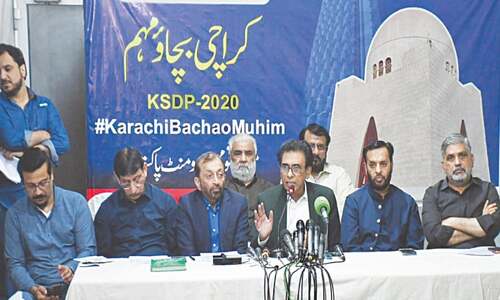
The leader of the opposition in the Sindh Assembly, Ali Khurshed, told a press conference on March 24: “Let’s sit together and discuss Article 140-A of the Constitution and work to strengthen the LG [local government] system under it. Constitutional amendments can come later, but for now, Sindh’s existing laws still need to be improved.”
The next day, the MQM-P’s top leadership warned of a ‘final decision’ regarding its alliance with PML-N at the centre if the 28th Amendment to empower the people at the grassroots is not passed. The MQM-P Chairman Khalid Maqbool Siddiqui reminded Prime Minister Shehbaz Sharif that the April 22 agreement on Constitutional guarantees under Article 140-A has yet to be fulfilled.
In its latest report, the Auditor-General of Pakistan stated that excessive dependence on government funding has led to a decline in municipal revenues, as municipalities consistently fail to meet their assigned targets. This dependence has also affected development work.
Mr Bhutto’s discussions with provincial authorities also focused on enhancing municipal institutions’ capacity to address public issues effectively and on improving grassroots governance.
In the absence of effective local bodies, the provinces fall short of making sustained efforts to involve citizens meaningfully in fighting environmental challenges. This, says an analyst, “is a top-down governance model setup at the core of all plans and actions initiated by the government”.
Partnership for development with citizens is the ideal and practical way forward to responding to climate change and making it more inclusive and effective, says Public Policy analyst Hamid Masood. He added: “Democratic participation in environmental governance comes at no cost to the national exchequer, nor do we need international financing for such corrective measures.”
Though Karachi’s recent rainfall was not extraordinary by monsoon standards, analysts point out that the sudden squall that swept across the metropolis was enough to uproot trees, damage property, and tragically claim at least 20 lives.
When local body elections across Pakistan are postponed, final authority remains with higher tiers, and executive discretion replaces participatory decision-making, wrote development practitioner Shakeel Ahmed Shah in his article in The Express Tribune. He notes that “The outcome is a vacuum that breeds patronage, parallel authorities and public alienation.”
In another move to reduce tensions between federal and provincial governments, and on PPP’s insistence, the constitutional vertical distribution of National Finance Commission resources between the Federation and the provinces is no longer under review, Planning Minister Ahsan Iqbal recently clarified.
Speaking to the media, Sindh Chief Minister Syed Murad Ali Shah said the provincial infrastructure under federal projects is in a dilapidated state. He pointed out that the Jamshoro-Sewan road has been incomplete for nine years despite initial funding by the Sindh government way back in 2017.
The federation needs to reform its institutional framework by withdrawing from functions that the 18th Amendment devolves to the provinces and reduce its current expenditure effectively.
To quote analysts at Dawn, “Reforms should be guided by the principle of cooperative federalism to strengthen the federation.”
Published in Dawn, The Business and Finance Weekly, March 30th, 2026