Ex-Afghan general, agent’s pleas against arrest, deportation rejected


• Petitioners cite fear of Taliban persecution if sent back to Afghanistan
• Peshawar High Court notes fears of detention and removal don’t constitute valid cause of action
• Rules immigration, visa and residency matters fall within executive’s domain
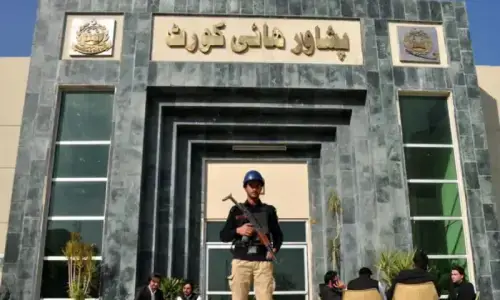
PESHAWAR: The Peshawar High Court (PHC) has rejected petitions filed by a former general of the erstwhile Afghan National Army and a special agent of the former Afghan Presidential Protective Service (PPS), along with their families, seeking protection against their imminent arrest and deportation by law enforcement agencies.
A bench comprising Justices Wiqar Ahmad and Kamran Hayat Miankhel dismissed two almost identical petitions filed by former general Baryalai Sharifi and former PPS special agent Abdul Mujeeb Ghairat and their family members. They had approached the court fearing persecution by the Taliban government in Afghanistan if deported.
The counsel for Mr Sharifi submitted that his clients were Afghan nationals who had entered Pakistan on valid visas.
He claimed that Mr Sharifi had served as a general in the former Afghan National Army (Milli Urdu) and that he and his family had received threats from the present Afghan regime.
He added that Mr Sharifi’s wife had served as an assistant doctor in the PPS of the former Afghan government, while his son claimed to have worked as a training camp guard in the same service.
The counsel further stated that Mr Sharifi had approached the Society for Human Rights and Prisoners’ Aid (SHARP) for pre-screening in connection with an international protection and resettlement process, and apprehended that the petitioners might be arrested or deported from Pakistan.
‘Mere apprehension’
“The petitioners have not challenged any specific order, notification or action of the respondents adversely affecting their legal or fundamental rights,” the bench observed in its four-page written order.
“The entire case rests upon a mere apprehension that they may, in future, be subjected to arrest, detention or deportation. Such speculative apprehension, without any concrete cause of action or demonstrated violation of law, does not furnish a valid ground for invoking the extraordinary constitutional jurisdiction of this court under Article 199 of the Constitution,” it added.
The court observed that “matters relating to the stay of foreign nationals in Pakistan, grant, extension or cancellation of visas, and their immigration status are governed by the relevant statutory framework and fall within the exclusive domain of the competent executive authorities”.
“Any request for international protection, refugee processing or resettlement through SHARP, UNHCR or any third country does not, by itself, create an enforceable legal right against the respondents capable of being enforced through a constitutional petition,” it held.
Similarly, in the case of Mr Ghairat, counsel submitted that the petitioner and his family were residing in Pakistan on valid visas and had applied online for their renewal.
He stated that Mr Ghairat had served as a special agent in the former PPS, an elite US-trained security unit responsible for the close protection of the then Afghan president.
The counsel argued that owing to his previous service under the former Afghan government, Mr Ghairat and his family would face danger if returned to Afghanistan.
He contended that in view of the ongoing action against certain Afghan nationals, the petitioners feared arrest and deportation despite their claimed lawful stay in Pakistan.
“The questions relating to the petitioners’ right to remain in Pakistan, renewal or extension of visas, or their immigration status fall within the exclusive domain of the competent executive authorities under the relevant immigration and foreigner laws,” the bench observed.
“In the absence of any unlawful action, refusal of a statutory request, or infringement of a vested legal right, no writ can be issued directing the respondents to grant protection or confer a legal status upon the petitioners.”
Published in Dawn, August 7th, 2026