

Carbon credits explained: How Pakistan can turn climate action into investable projects
Across the country, businesses are investing in renewable energy, waste management, cleaner production, efficient transport, agriculture and nature-based solutions.
And these are the same opportunities that can be turned into climate assets.
But there is an important distinction also: not all low carbon emission projects are carbon creditable also. Installing solar panels, planting trees or capturing methane does not automatically generate carbon credits. A project must demonstrate that its emission reductions or removals are additional, measurable and consistent with an accepted carbon-market methodology. It must also establish who owns the reductions, how they will be monitored and whether the expected revenue justifies the cost of registration and verification.
For corporate leaders, the first question should be: “can this project credibly produce saleable carbon credits?”
Carbon credits explained: What is actually being sold?
A carbon credit represents one metric tonne of carbon dioxide equivalent, or tCO₂e, that has been reduced, avoided or removed from the atmosphere and verified under an accepted standard.
Credits can be generated by different activities. A landfill may capture methane that would otherwise escape into the atmosphere. A clean-cooking program may reduce the amount of fuel consumed by households. A biochar facility may convert agricultural residues into a stable form of stored carbon. Forestry and agroforestry projects may increase carbon stored in trees and soil.
Readers seeking a more detailed introduction can consult Resources Future’s guide to carbon credits, project types and market standards.
Two carbon markets, one demand for high-integrity
Carbon markets broadly operate through two channels.
In voluntary carbon markets, companies purchase credits as part of climate, sustainability or net-zero strategies. Participation is generally not imposed by law, although buyers are increasingly expected to explain what they purchased, why they purchased it and how the credits relate to their wider decarbonisation plans.
Compliance markets operate under government or international rules. Regulated entities may be required to surrender eligible units against their emissions, while international transfers under Article 6 of the Paris Agreement require national authorisation and careful accounting.
For project developers, the route chosen affects methodology, documentation, buyers, price expectations and regulatory approvals. A credit that is acceptable to one buyer or program may not necessarily qualify for another.
Across both markets, however, the direction of travel is clear: buyers increasingly differentiate between credits on the basis of high-integrity. Carbon markets are becoming less tolerant of weak baselines and unsupported claims.
Pakistan now has a national policy framework
Pakistan’s carbon-market opportunity gained a clearer institutional foundation with the federal government’s approval of the Pakistan Policy Guidelines for Trading in Carbon Markets 2024. The framework recognises voluntary and compliance carbon markets and is intended to align carbon trading with Pakistan’s climate commitments and Article 6 of the Paris Agreement.
The Ministry of Climate Change and Environmental Coordination is designated as the National Designated Authority. The policy outlines a pathway beginning with a Project Idea Note, followed by a Letter of Intent, development and registration of a Project Design Document and, where applicable, a No Objection Certificate for the transfer of mitigation outcomes or corresponding adjustments.
The framework also envisages a Carbon Market Working Group, a National Carbon Registry and domestic MRV infrastructure. These systems are important because buyers need assurance that a reduction has not been issued, sold or claimed more than once.
Pakistan’s framework also has direct financial implications for developers. It provides for a five per cent deduction of generated credits, a Corresponding Adjustment Fee calculated at 12 per cent of net revenues where applicable and an administrative charge equal to one per cent of gross carbon-credit revenues. These deductions need to be reflected in project economics from the beginning.
Resources Future has provided a detailed analysis of Pakistan’s 2024 carbon-credit policy and its implications for developers. The underlying provisions can also be reviewed in the government’s official policy guidelines.
The policy creates a pathway, but it does not make every climate activity eligible. An approval pathway is not a guarantee of registration, credit issuance or revenue. That is why feasibility is the critical first investment gate.
The 11 questions to answer before spending on carbon credit registration in Pakistan
Carbon project development can require specialised studies, baseline surveys, stakeholder consultations, legal documentation, validation fees and years of monitoring. Developers that move directly from an attractive idea to registration risk investing heavily before establishing whether the fundamentals work.
Resources Future has an 11-Parameter Carbon Feasibility Study to give companies, developers and investors an early Go/No-Go assessment. Rather than beginning with a promise of how many credits a project might sell, the study tests the conditions that must be present for those credits to become credible.
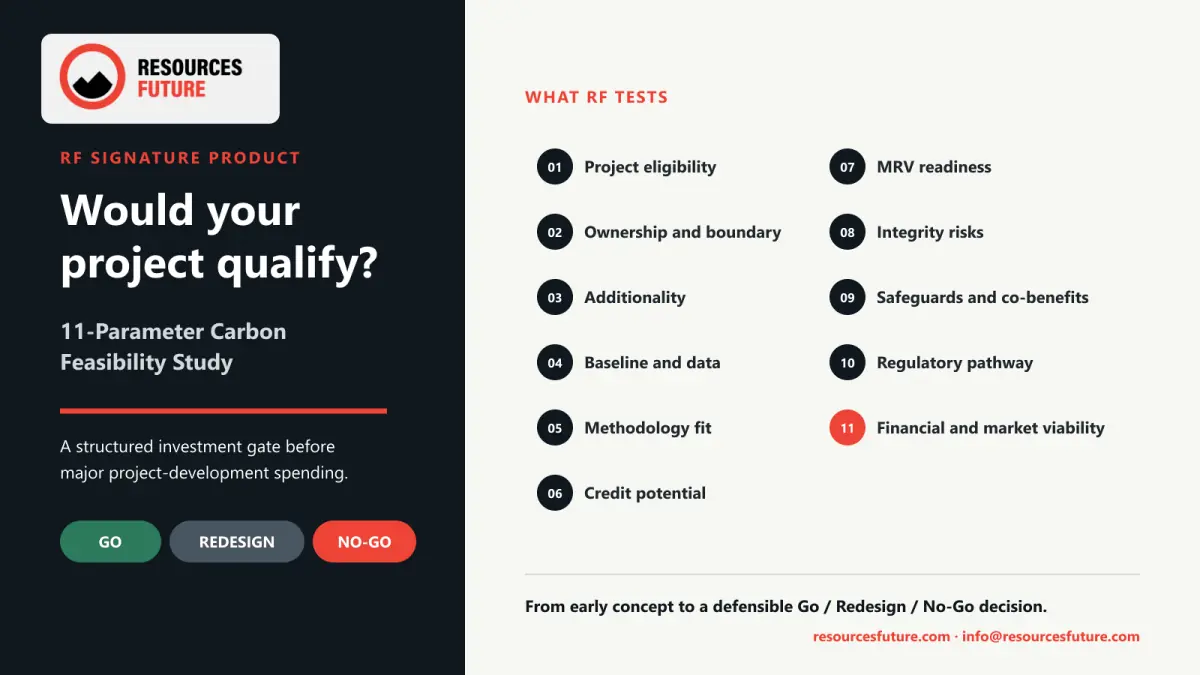
In practical terms, an effective screening needs to examine 11 decision areas:
- Project eligibility: Does the proposed activity qualify under an accepted carbon-crediting program?
- Project boundary and ownership: Which activities, locations and emission sources are included and who holds the legal rights to the resulting credits?
- Additionality: Would the emission reduction or removal occur without carbon finance?
- Baseline: What would reasonably happen in the absence of the project and is there sufficient evidence to support that scenario?
- Methodology and standards: Is there an applicable methodology under a recognised program or Article 6 pathway?
- Credit potential: How many credits could the project realistically generate under conservative assumptions?
- Data and MRV readiness: Can the necessary information be measured, recorded and independently verified over the project’s life?
- Integrity risks: How will leakage, reversal, double counting and underperformance be addressed?
- Safeguards and co-benefits: How will communities, workers, landholders and the environment be protected—and how will benefits be shared?
- Regulatory pathway: What national, provincial and international approvals will be required?
- Financial and market viability: After development costs, verification expenses, policy deductions and price risk, does the investment case still work?
This assessment is particularly valuable for boards and investment committees. It converts an abstract climate opportunity into a structured decision: proceed, redesign, collect more evidence or stop before committing further capital.
RF’s overview of carbon credits in Pakistan and the 11-Parameter Carbon Feasibility Study explains how the initial screen connects with full feasibility, registration and MRV support.
Where could Pakistan generate carbon credits?
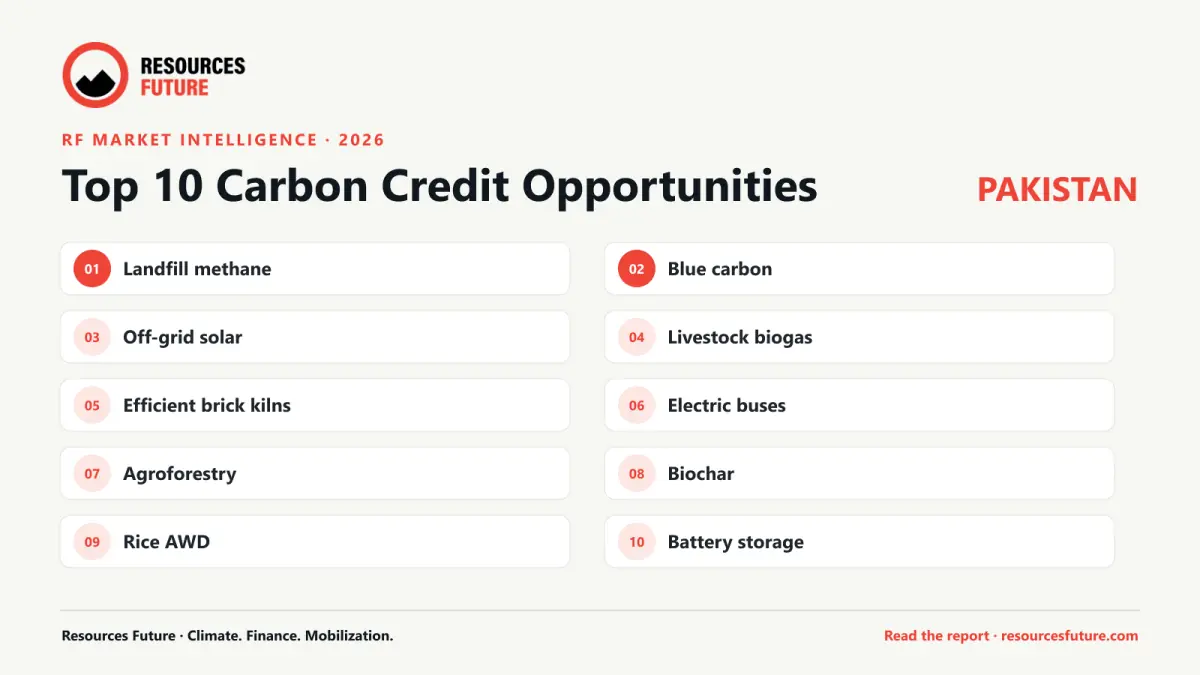
Pakistan’s opportunity is not confined to forestry. Potential project categories include methane capture from livestock and waste, clean cooking, agricultural practices, biochar, industrial efficiency, transport, distributed energy and selected nature-based solutions.
For instance, a large plantation may appear attractive but become difficult to certify if land rights are fragmented, the baseline is weak or long-term permanence cannot be protected. Conversely, a methane-reduction project with strong operating data may offer more predictable monitoring and issuance.
RF’s research on the top carbon-credit opportunities in Pakistan assesses sectors against methodological maturity, MRV feasibility, additionality and commercial potential. Its specialist work on agriculture, forestry and land-use carbon projects also illustrates why land eligibility, permanence, leakage and community safeguards must be tested early.
From feasibility to registration and issuance
A positive screening result is the beginning.
The next stage is a full feasibility assessment. This establishes the baseline in greater detail, selects the methodology, calculates expected emission reductions, designs the monitoring system, assesses safeguards and models financial outcomes under different price and issuance scenarios.
The project can then proceed through national approvals and preparation of the Project Design Document. Depending on the chosen pathway, it may also require listing under an international standard, independent validation, registration, monitoring and verification before credits are issued.
Each stage depends on the quality of the previous one. Poor baseline work creates problems during validation. Weak monitoring design creates problems during verification. Overstated credit estimates create problems with investors and buyers.
Resources Future’s carbon-credit project development guide describes the wider journey from feasibility and methodology selection to registration, verification and market access.
This is also where early commercial planning matters. Developers need to understand not only how credits will be created, but who might buy them, what quality attributes those buyers value and whether an offtake or forward-purchase arrangement could support financing.
Turning estimated credits into an investment case
Even a technically eligible project may not be financially viable.
Carbon revenues depend on credit volume, price, issuance frequency and other factors. A project generating credits every year will have a different cash-flow profile from one verified every three or five years. An investor holding credits over the full project life will face different risks from one planning an early sale of future credit rights.
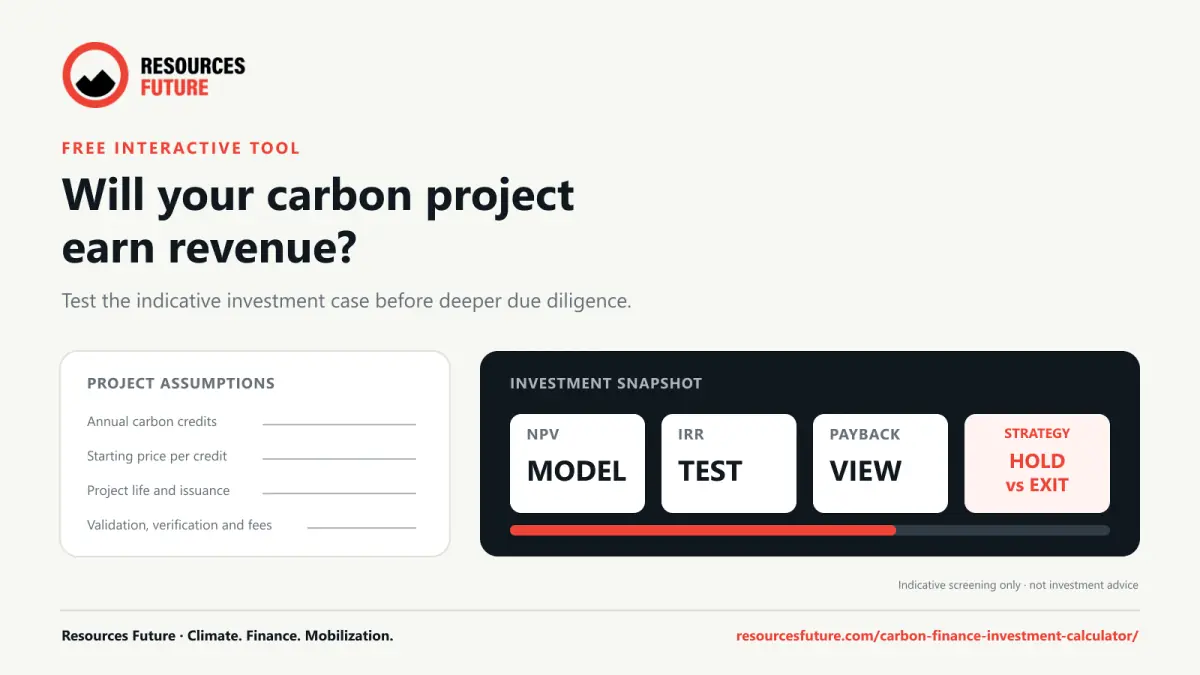
To help decision-makers test these variables, Resources Future has developed a free Carbon Credit Investment Screening Tool. The tool models indicative revenue, costs, NPV, IRR, payback period and hold-versus-exit scenarios.
It does not replace a full carbon feasibility study, legal due diligence or independent investment appraisal. Its value is in helping C-suite decision-makers challenge headline revenue assumptions before approving deeper expenditure.
A credible model should also use scenarios rather than a single carbon price. Conservative, base and upside cases make it easier to see whether the project remains viable when credit issuance is delayed, costs increase or market prices disappoint.
What should corporate leaders do now?
Companies may participate in carbon markets in several ways.
An asset owner may discover that an existing waste, energy or agricultural program has the potential to generate credits. A project developer may use carbon revenue to improve the viability of new infrastructure. An investor may finance a portfolio in return for a share of future credits. A corporate buyer may purchase and retire high-quality carbon offsets for residual emissions.
Each role requires different capabilities, but the first actions are similar: identify potential activities, establish data ownership, screen eligibility, test financial viability and select the correct regulatory and certification pathway.
Resources Future supports this process from initial screening through full feasibility, Project Idea Note and Project Design Document preparation, MRV design, validation and verification coordination, registration, issuance strategy and buyer engagement.
That is the opportunity for Pakistan’s corporate sector: not simply to trade carbon, but to develop credible climate assets capable of attracting investment, generating revenue and delivering measurable benefits.
The market will reward proactiveness. The right place to begin is a solid carbon credit feasibility.
Resources Future is a climate finance mobilisation firm with a focus on carbon-market advisory and accessing green climate funds. To explore whether a project could qualify for carbon-credit development, visit Resources Future or contact info@resourcesfuture.com.
This content is an advertorial by Resources Future and is not associated with or necessarily reflective of the views of Dawn.com or its editorial staff.