
We can all agree that the past decade has been remarkable for the human race.
This was the era when mankind peered back to the dawn of the universe through the first images from the James Webb Space Telescope, while also shaping its future by creating deep learning models capable of complex reasoning.
We pushed the boundaries of both space and sea. We landed the Perseverance rover on Mars and watched Ingenuity achieve the first powered flight on another planet. We cheered on as American Victor Vescovo descended nearly 11 kilometers to the bottom of the Mariana Trench, the deepest known point on Earth, only to find that plastic debris had beaten him there.
It’s no secret, we’re the smartest creatures God put on planet Earth, but for a species capable of rewriting its own DNA and flying aircraft on another planet, we seem to be incredibly stupid, too.
For one, we’re determined to follow in the footsteps of the previous tenants, who dominated the planet’s ecosystems for 160 million years. It seems for the past century, despite unprecedented technological breakthroughs and medical advancements, mass extinction seems to be our most ambitious long-term goal.
From Mars rovers to melting glaciers, 2026 is proof we have the intelligence to solve the climate crisis and the will to ignore it
Each political decision, every emissions milestone, every climate catastrophe and every “hottest year on record” isn’t just another metric but a small victory in a race we’re somehow determined to win.
What began as rising temperatures on a graph and was once “the greatest con job ever perpetrated on the world” (Donald Trump’s words, not mine), is now an actual threat that’s increasingly difficult to laugh off. The scoreboard today reads like a catalogue of disasters: heatwaves, floods, wildfires, droughts and rising sea levels. If this is our long-term strategy, it seems to be working remarkably well for us.
Global sea surface temperatures remain among the highest ever recorded, fuelling stronger storms, marine heatwaves and widespread coral bleaching. We’ve melted an estimated nine trillion tonnes of glacier ice and raised global sea levels by more than 10 centimetres since 1993.
But hey, better book those tickets to the Maldives while there’s still a beach to put your towel on.
And while future generations in the East may inherit plenty of waterfront property, Europe seems to be on a different trajectory altogether.
More than 10,000 excess deaths were recorded across the region in just one week of June 2026, as temperatures rewrote the record books. Germany reached an unprecedented 41.7 degrees Celsius, Czechia climbed to 41.9 degrees Celsius, Poland hit 40.5 degrees Celsius, while Paris baked at 40.9 degrees Celsius. Why fly south when nature’s bringing the Mediterranean home? And Europe’s rivers ran so warm, they disrupted shipping and left nuclear power plants struggling to cool their reactors.
Elsewhere, the rain gods decided to overcompensate. Torrential rains flooded cities and towns across China, Pakistan, Nigeria and other parts of West Africa, leaving a trail of death, disease and destruction.
Then there’s Canada, the land of brutal winters, seemingly unable to catch a break. As climate change leaves its forests hotter and drier, even the tiniest spark ignites a massive blaze. And so the country burnt. Again. Just like Spain, Turkey and Greece.
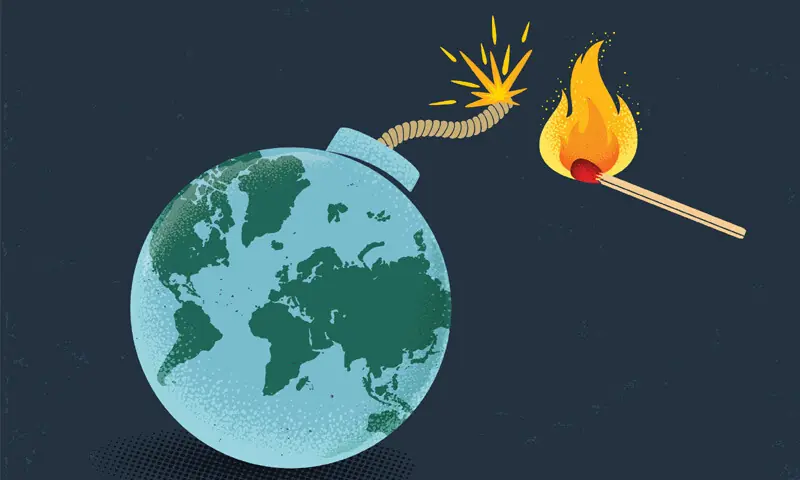
But you see, unlike the dinosaurs, we’re smart. We’re one step ahead. Those poor lizards didn’t even know what hit them. We, on the other hand, with our average IQ of 100, have watched our asteroid coming for decades and spent the last 50 years debating its existence. We’ve published reports, signed pledges, held climate summits, debated net-zero emissions, launched glossy sustainability campaigns and perfected the art of greenwashing, occasionally arguing over whether the asteroid heading toward us actually exists.
Of course, we could have done more. We could have demanded action, reduced our carbon footprint and swiftly implemented policies that might have delayed — or even prevented — these disasters.
But all that effort felt... what’s the word for it? Ah, yes, inconvenient.
Besides, back when former US Vice President Al Gore started warning us, it sounded more like a ‘tomorrow problem.’ Well, tomorrow is here and we can see the asteroid headed our way. The only problem now is that we seem to be dead set on going out with a bang. Or simply ending it all with a shrug.
It’s 2026, and we’re on track for yet another exceptionally warm year. The planet is still on fire and, for a species that prides itself on intelligence, we’ve shown a remarkable reluctance to learn from our mistakes. Instead of asking how to ‘avoid’ a hotter future, we’re focused on making it more bearable for ourselves and, where possible, more profitable.
Governments are designing cooler cities. Architects are building heat-resistant homes. Employers are rewriting work schedules around extreme temperatures. Companies such as Schneider Electric, Heineken and Wates Group have introduced heat resilience programmes, wearable heat sensors, cooled rest areas and altered work schedules.
Climate change has become as much a business opportunity as it is a global emergency. Air conditioner sales have surged globally, with the world expected to have over 5.5 billion units by 2050, up from around two billion until a few years ago. The irony, of course, is that many air conditioners still rely on electricity generated from fossil fuels. Our solution to a warming planet is, in many places, helping warm it a little faster.
We’ve turned environmental concern into a marketing strategy. Companies proudly advertise “green” credentials while quietly continuing practices that contribute to the problem, a phenomenon so common it has earned its own name: greenwashing. We fly thousands of kilometres to “eco-lodges” to reconnect with nature, congratulating ourselves for offsetting the emissions from the flight that got us there.
Collectively, we’ve accepted a future we’re still capable of changing. Our plan is to watch the world burn from a safe distance until, inevitably, the flames engulf our front door. It is then when we’ll spring into action and demand, ‘Why didn’t anybody warn us?’
Postscript: Parts of this article were written with the help of AI, a technology that, like so many modern conveniences, consumes electricity and water. Just to prove my point, somewhere large data centres created a “data heat island effect”, raising local land surface temperatures around the facilities by an average of 2 degrees Celsius or more.
The writer is a humour columnist and fiction
writer based in Karachi
Published in Dawn, EOS, August 23rd, 2026