It was an overcast evening on July 31, 2026. Taj Muhammad Shah, 49, was ploughing his small plot of land with a tractor on the outskirts of his village, Borli Mahmood Shah, also known as Borli Muhammad Shah, near Islamkot in Tharparkar, Sindh.
Several workers were with him, including 40-year-old Sajan Meghwar and his 11-year-old son Amrat, who worked as farmhands. After finishing the day’s work, Shah and the father-son duo lay down under a tree to rest. The other workers rested nearby.
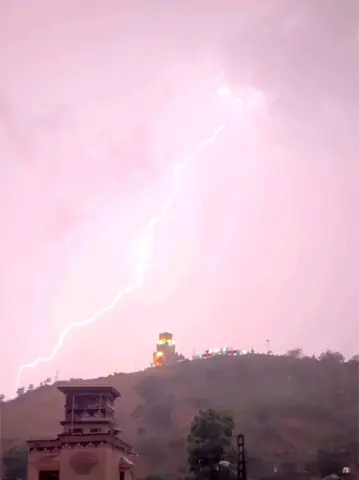
The stillness of the sandy, arid landscape was broken by successive peals of thunder, accompanied by bolts of lightning zigzagging through the sky. One such strike hit the tree under which Shah and his two workers were resting, killing all three.
Several others nearby sustained injuries but survived. “It happened so fast, we didn’t have any opportunity to react,” says Diam Meghwar, one of the survivors.
Once welcomed as a sign of rain and relief, lightning has become a source of fear in Tharparkar. As coal mining transforms the landscape, scientists are examining whether climate change, industrial activity or both are altering the region’s storms
A BLESSING NO MORE
For generations, rain has been celebrated in Tharparkar, where persistent droughts have left agricultural communities heavily dependent on pastoralism. “We would be glad to see lightning and hear thunder because they brought hope,” says 50-year-old villager Seeta.
But that relationship has changed in recent years, as lightning strikes have resulted in mounting losses of life, livestock and property.
According to 2025 data from the District Disaster Management Authority (DDMA) Tharparkar, more than 350 people have lost their lives in lightning strikes across Tharparkar since 2018, while thousands have been injured. Thousands of cattle have also been lost during this period.
While the DDMA figures cover the entire district and a longer period, another report, by the Islamabad-based Policy Research Institute for Equitable Development (PRIDE), was based on documented incidents in 46 villages. The report, published in November 2024, claimed that 91 people were killed in the 46 incidents reported between November 2019 and July 2024. Of these, 27 incidents occurred during the monsoon in July, while the remaining 19 occurred in winter.
“Whenever it rains and lightning strikes now, we wish for it to stop,” Seeta tells Eos. “This way, at least our lives and those of our loved ones will be safe.” She adds: “We had lightning in the past too, but it has become extremely frequent and lethal over the last decade or so.”
WHAT HAS CHANGED
So, what is the reason for this apparent change? For many residents of Tharparkar, the answer seems to be simple: coal mining and power generation.
The Sindh Engro Coal Mining Company (SECMC) started mining operations in Tharparkar in 2016. A joint venture of the Sindh government and Engro Powergen, SECMC has 13 investment blocks, stretching over 9,000 square kilometres of the district, with an estimated 158.75 billion tonnes of lignite coal buried beneath.
Currently, two blocks are operational — Thar Coalfield Blocks I and II (TCB-1 and TCB-II) — with associated power plants generating 2,620 megawatts of electricity for the national grid.
The mines and the power plant are located within 30 kilometres of Islamkot, which the PRIDE report identified as a potential lightning hotspot. Many residents seem convinced there is a causal linkage between the mining and the increase in number of lightning strikes in the region, even though both the Sindh government and SECMC have repeatedly said that data from the meteorological department doesn’t establish such a link.
WHAT THE SCIENCE SAYS
Climate scientists have warned that a warming world can intensify extreme rainfall and alter the conditions that favour severe thunderstorms in some regions.
While attributing every ecological change directly to mining would be scientifically inaccurate, dismissing local concerns would be equally unwise, says Prof Fahim Khokhar, who heads the environmental sciences department at the National University of Science and Technology (NUST) in Islamabad.
At the same time, Prof Khokhar continues, local changes in Tharparkar may also be a contributing factor. Large-scale mining operations, thermal power generation, increased vehicular traffic, land-use changes, wastewater reservoirs and industrial emissions have altered local environmental conditions.
“Sulphate particles, dust and other airborne pollutants [associated with mining, coal combustion and other industrial activity] may affect the development of thunderstorms under certain conditions, although their exact relationships remain complex and location-dependent,” he explains.
According to Prof Khokhar, preliminary investigations have identified enhanced lightning activity in the vicinity of certain mining zones and wastewater reservoirs, coinciding with variations in relative humidity, aerosol concentrations, and convective atmospheric conditions conducive to thunderstorms and lightning.
“These observations do not establish direct causation but raise important scientific questions regarding the interaction between global climate change and local anthropogenic influences on atmospheric conditions,” he adds.
LIGHTNING ON THE GROUND
One factor that may increase the danger posed by lightning in Tharparkar, says Prof Khokhar, is the region’s dry, sandy soil, which has relatively high electrical resistivity. “The soil lacks moisture and organic matter, making it difficult for the current to dissipate.”
Sparse tree cover and the scarcity of tall structures can also leave people in the open relatively exposed during thunderstorms. Paradoxically, an isolated tall tree provides a prominent strike point — as happened in the case of Shah and his two workers.
One long-term way to mitigate the impact of lightning strikes is to install properly designed lightning-protection and grounding systems that provide a preferred, controlled path for the electric current.
A lightning rod is an external device mounted on top of a structure to intercept and divert high-voltage lightning surges. An earth electrode, such as a metal rod driven into the ground, provides a path for the electrical current to dissipate into the earth.
In the nearby village of Godanagri, residents have installed three earthing rods in recent years. “We have not suffered any losses to lightning since then,” says one resident Deewan Kumar.
At least one local charity, the Umerkot-based Association for Water, Applied Education and Renewable Energy, has been working with communities to raise awareness about safety measures during lightning strikes.
“Tharparkar requires systematic, long-term monitoring of lightning, rainfall, temperature and thunderstorm patterns, so that we can establish how lightning frequency and intensity are changing and understand the relationship with climate change,” says Ali Akbar Rahimoo, its executive director.
Until that evidence emerges, for the people of Tharparkar, the safest response may be to treat every rumble of thunder not as a promise of rain, but as a warning to seek shelter.
Corrigendum: The print version of this article incorrectly identified Sajan and Amrat Meghwar as brothers instead of father and son. The online version has been corrected.
Dolat Chandani is a rights activist
based in Mithi. X: @ChandaniDolat
Hussain Dada is a member of staff.
X: @hydada83
Published in Dawn, EOS, August 23rd, 2026