Spantik Peak mission to retrieve body of Pakistani climber halted amid heavy snowfall
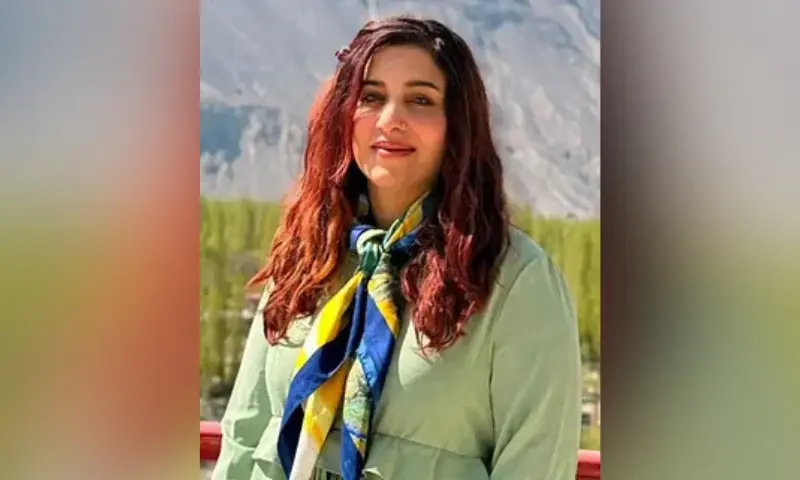

GILGIT: Snowfall at Spantik Peak on Sunday halted efforts to retrieve the body of Pakistani climber Dr Asma Mushtaq, who died while descending the 7,027m peak in Gilgit-Baltistan’s Shigar district.
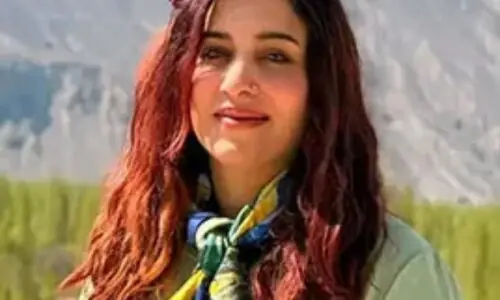
34-year-old Dr Mushtaq died at an altitude of around 6,250 metres on Thursday while descending from the summit of Spantik — also known as Golden Peak — after suffering from high-altitude sickness. Her body is currently at Camp 3.
High-altitude sickness encompasses a range of pulmonary and cerebral conditions caused by hypoxia, or oxygen deprivation, due to rapid ascent and inadequate acclimatisation to high altitudes.
Baltistan Division Commissioner Kamal Khan told Dawn that the rescue team of six high-altitude porters had reached Camp 2 and had attempted to start their mission towards Camp 3, but were forced to retreat back to Base Camp due to heavy rain and snow.
“Due to continuous heavy snowfall and extremely strong winds, conditions have become very dangerous and risky,” he said. “The rescue team could not safely remain at Camp 2, therefore, the entire rescue team had to turn back.”
He said that the team had now reached Base Camp safely and that further rescue efforts would be considered when the weather conditions improved.
“The mission is being undertaken under extremely challenging high-altitude and weather conditions, and the safety of the recovery team remains a priority,” he said.
According to a press release issued by the Alpine Club of Pakistan (ACP) General Secretary Ayaz Shigri on Saturday, Dr Mushtaq’s body remains at approximately 6,400m.
“The recovery team departed yesterday (i.e. Friday) and reached Camp 2 today (Saturday), but operations have been halted due to heavy snowfall,” the statement said. “The team has been advised to return to Base Camp and wait for a suitable weather window.”
Approval for a mercy mission for helicopter rescue on humanitarian grounds was also in progress, with the support of the Pakistan Army, it added.
The ACP statement noted that the recovery operation, consisting of climbers from different teams, was being coordinated by Dr Mushtaq’s own expedition company, in coordination with institutions including the tourism department, local government and ACP.
“It was earlier reported that Dr Asma suffered from high-altitude sickness after summiting,” the press release said. “The circumstances surrounding her death, as well as the conduct and response of the expedition company, will be fully investigated once the teams are safely down and her body has been recovered.”
Any necessary action would follow the findings of that investigation, it added.
It also clarified ACP’s role in the venture, stating that the club was Pakistan’s national federation for mountaineering and sport climbing and not a rescue organisation with dedicated resources.
Search, rescue and other relevant activities depended upon government resources, it noted, while regretting that Pakistan currently lacked a dedicated and properly established high-altitude rescue system.
The ACP said that under the new leadership of the club, it was working with the relevant authorities to help with the development of an effective rescue framework and support improvements to the country’s mountaineering infrastructure.
“Please refrain from spreading misinformation or making unverified claims about the recovery operation,” the club requested, noting that the safe and dignified recovery of Dr Mushtaq’s body was the priority.
Shigri told Dawn that misinformation was being spread about the delay in the recovery of the body.
He said that efforts were being made to recover the body from the peak and transport it to the base camp so that it could be airlifted via helicopter, pointing out that helicopters could not retrieve the body from altitudes over 6,000m.
“Only the ground rescue team can bring down the body from the peak to base camp,” he said, noting that a six-member local team was making efforts in this regard.
“Initially, certain confusions arose regarding the remuneration demanded by the high-altitude porters for undertaking the body recovery operation, which resulted in a delay in commencement of the recovery mission,” Khan told Dawn.
According to the commissioner, no agreement had been signed between the tour operator and the mountaineer, and no insurance had been arranged for helicopter evacuation.
The matter was subsequently taken up through the joint intervention and coordination of the Baltistan division civil administration, the tourism department, the GB government, EV-K2-CNR — an Italian NGO paying the expenses of the ground rescue team — and the ACP, he said.
“Through their coordinated efforts, the matter was amicably resolved, and the required arrangements were finalised,” he added.
Earlier, the commissioner had told Dawn that the tour operator had violated mountaineering rules by not arranging for the recovery team to retrieve Dr Mushtaq’s body from Spantik Peak and for helicopters to airlift the body from base camp to Skardu.
“Under the rules, if a ground rescue team or helicopter is needed, the tour operator is responsible to arrange a rescue team and pay insurance for helicopter,” he said.
The commissioner added that the operator had not conducted a briefing or debriefing either, which he said was mandatory under the Mountaineering Rules 1999.
However, Khan rejected the “wrongful” impression that the recovery mission was delayed by the operator’s negligence, noting that the division and district administrations had arranged the ground team soon after the incident with an NGO paying the expenses.
The Pakistan Army also agreed to provide a helicopter to airlift the body from the base camp to Skardu on humanitarian grounds.
He said the mission depended on the weather: “If the weather allows, the rescue team will bring the body down to base camp, and army helicopters will airlift it from the base camp to Skardu.”
Experts say bringing a body down from a high-altitude peak, particularly from above 6,000m, is an extremely risky and challenging task. In many cases, bodies at such extreme altitudes are left and buried under the snow rather than being brought down.
Sajid Sadpara buried the body of his father, renowned Pakistani mountaineer Ali Sadpara, at around 8,000m on K2 in 2021.
GB tourism department officials requested that people consider the risks and circumstances carefully before making comments about Dr Mushtaq’s case.
Information Minister Ataullah Tarar also shared the update on his X account.
He further stated, “Heli has been authorised and coordination has been done between [the] GB government and Force Commander Northern Areas. Alternate arrangements are also in place. Whatever can be done in these circumstances will be done,” he wrote, adding that Prime Minister Shehbaz Sharif was being “kept updated on the situation.
According to her social media profiles, Mushtaq was originally from Lahore and worked as a UK-based doctor specialising in obstetrics and gynaecology.
Away from her medical profession, she was a passionate traveller, vlogger and mountaineer who actively documented her expeditions on social media. She completed a successful winter ascent of the 4,076-metre Musa ka Musallah peak and was associated with expeditions to Rupal and Arandu.
In a 2024 post seeking K2 sponsorship, she described herself as “a doctor and mountaineer”.
Broad Peak operation remains halted amid bad weather
Meanwhile, due to continued bad weather conditions, helicopters were unable to fly to Broad Peak to airlift the body of US climber Sarah Mallory Geis from the base camp after the deadly avalanche that killed a 10-member expedition.
The body of US climber was recovered by three local porters voluntarily from Broad Peak (8,047m) on Friday, 22 days after she went missing in a deadly avalanche.
Local volunteers have moved the body to Broad Peak basecamp.
Shigri said that as the weather improved, the body of the US climber would be airlifted to Skardu via Pakistan Army helicopters.
Geis was among the 10 members of an expedition that went missing on July 30 after a deadly avalanche on Broad Peak.
The avalanche struck on July 30, cutting off contact with the international expedition led by world-renowned British-Nepali mountaineer Nirmal Purja on Broad Peak, one of the world’s highest mountains. Purja’s company later confirmed there were no survivors.
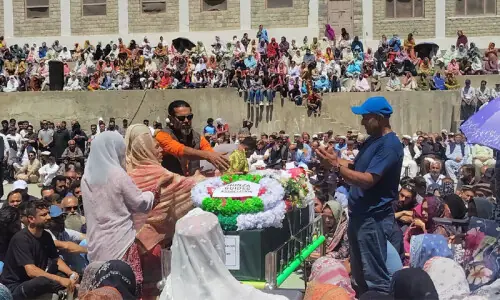
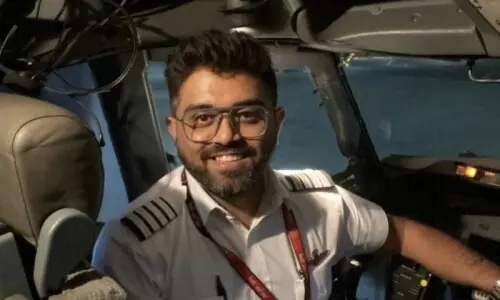
Shigri said that nine of the climbers, including Purja and Pakistani climber Sohail Sakhi, had so far been recovered and handed over to families. He added that the search for the tenth deceased member, Nawang Thindu Sherpa, would continue.
Broad Peak is the world’s 12th highest mountain, located in the Karakoram range, and is regarded as one of the toughest and most technical climbs of all the 8,000-metre-plus ascents.
It was first summited in 1957 by an Austrian team.