

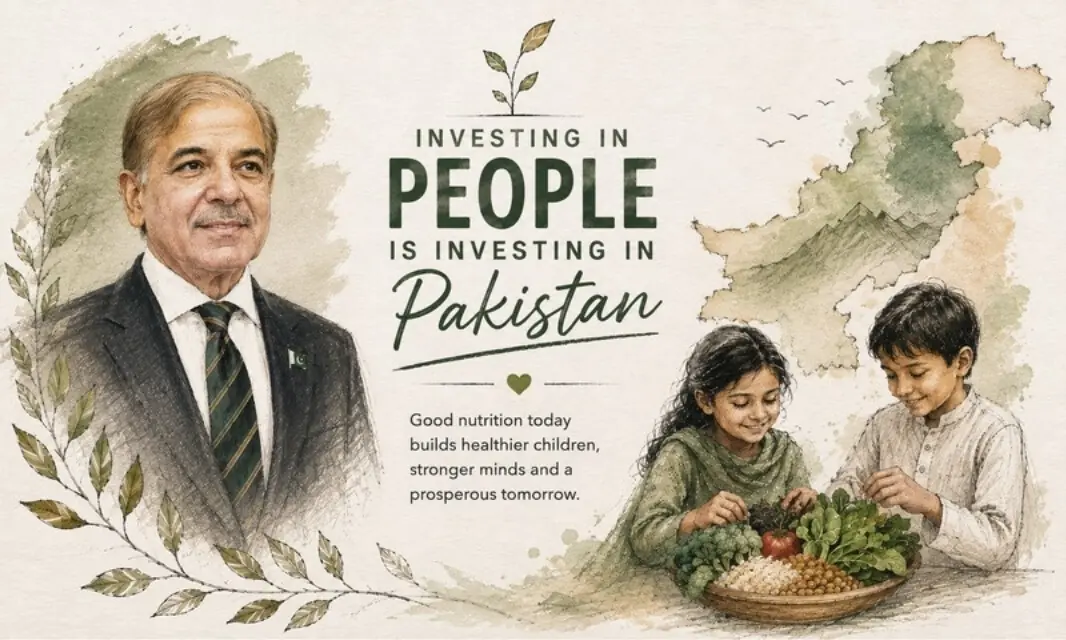
Four in ten children, one unfinished argument
When delegates gather at the Serena Hotel on September 2 for the opening of ACT For Nutrition, a two-day conference convened by DawnMedia under its ACT Pakistan initiative, they will not be discovering a crisis. They will be arguing about why a crisis that has been fully documented for the better part of a decade has moved so little.
The central figure is familiar to anyone who has read a nutrition report in this country. Roughly 40 per cent of Pakistani children under five are stunted, permanently shorter than they should be for their age, and, more consequentially, carrying cognitive and immune deficits that no later intervention fully reverses. The National Nutrition Survey of 2018, still the most recent nationally representative dataset of its kind, put the figure at 40.2pc across a sample of more than 76,000 children. Nothing published since suggests a meaningful improvement.
Stunting is the headline, but it is not the whole picture. The same survey recorded 17.7pc wasting among under-fives, children too thin for their height, the highest level ever measured in Pakistan and above the World Health Organisation’s 15pc emergency threshold. More than half of children aged six to 59 months were anaemic. Around 42pc of women of reproductive age were anaemic, and nearly half of pregnant women were iron deficient. Roughly 58pc of household water samples were contaminated with coliform bacteria, which matters enormously: a child with repeated diarrhoeal infection cannot absorb nutrients from food that is otherwise adequate.
The acute layer
Those are the chronic numbers. Layered on top is an acute emergency that has worsened sharply since the 2025 monsoon floods.
An Integrated Food Security Phase Classification (IPC) analysis covering 45 rural districts across Sindh, Khyber Pakhtunkhwa and Balochistan found more than 2.7 million children under five acutely malnourished, with around 706,000 expected to develop severe acute malnutrition — the life-threatening form requiring therapeutic treatment — before the end of September 2026. That represents roughly a 27pc increase in acute malnutrition cases against the 2023-24 analysis. Sindh accounts for the largest share, followed by Khyber Pakhtunkhwa, where flooding between June and October 2025 killed more than 500 people.
The food security picture behind it is comparably grim. Some 7.5 million people, about a fifth of the analysed rural population, were classified in IPC Phase 3 or worse between December 2025 and March 2026, including 1.25 million in Phase 4 — emergency conditions marked by large food gaps and high malnutrition.
A provincial map, not a national one
Nutrition in Pakistan is a devolved subject, and the aggregate national figure conceals a spread wide enough to make “the national average” close to meaningless.
Organisers of this week’s conference put stunting prevalence in Balochistan at 52ppam, among the highest recorded anywhere in the world, and in Sindh at 50pc, with acute malnutrition reaching 22.7pc in Tharparkar. Khyber Pakhtunkhwa’s figure is cited at 41.4pc, with 20.7pc of children severely stunted. In Punjab, the most populous province and the country’s agricultural engine, more than 60pc of women of reproductive age are described as anaemic.
That last statistic is the one that should unsettle policymakers most, because it undercuts the comfortable assumption that malnutrition is a problem of poor, arid, remote districts. A province that grows a substantial share of the country’s food cannot feed its own women adequately.
Chief ministers from Khyber Pakhtunkhwa and Sindh are scheduled to present their provincial pictures, with Punjab, Balochistan and Gilgit-Baltistan following. Whether those presentations produce commitments or communiqués is the open question of the week.
What is actually on the table
The conference agenda suggests the organisers understand where the argument has stalled.
One session is devoted to social protection, and specifically to the Benazir Nashonuma Programme, the government’s largest dedicated stunting-prevention effort, run through BISP with support from the World Food Programme, Unicef and WHO. It is the closest thing Pakistan has to a proof of concept. An independent midterm evaluation by the Aga Khan University’s Institute for Global Health and Development found a 6.4 percentage-point lower stunting prevalence among participating children under two, and children enrolled were reported to be around 22pc less likely to be stunted by six months of age. In July 2026 the programme was extended for three years to cover an additional 3.3 million women and children, taking its cumulative reach towards eight million people through 578 facilitation centres and 224 stabilisation centres.
A second session addresses financing, which is where the conversation usually collapses. The most cited estimate, from Nutrition International’s cost-of-inaction modelling, puts the annual economic cost of undernutrition at roughly $17 billion, about 4.6pc of gross national income, driven by lost productivity, healthcare expenditure, and an estimated annual loss of 21 million IQ points and 3.3 million school years. Against that, public health expenditure sits below 1pc of GDP, and nutrition has no dedicated federal budget line at all; spending is scattered across health, agriculture, education and social protection, which makes it nearly impossible to track and correspondingly easy to cut.
A third session, on behaviour-change communication, brings in the federal information minister and provincial information ministers, an acknowledgement that awareness campaigns built around posters and slogans have not shifted feeding practices, and that communication is a delivery function rather than a decorative one.
The conference is scheduled to close on September 3 with the launch of the Pakistan Nutrition Pact, described by organisers as a national framework of time-bound commitments and measurable targets across government, development partners, civil society and the private sector.
The test
Pakistan is not short of nutrition frameworks. It has a Maternal Nutrition Strategy, provincial nutrition cells, multi-sector plans, and three provinces with mandatory food fortification laws already on the statute books. What it has lacked is the machinery to make any of them bite.
The measure of this week, then, will not be the quality of the diagnosis. That work was finished years ago. It will be whether the Pact arrives with a budget line, a named accountable authority, and a date, or whether it joins the shelf.
This content is produced in paid partnership with the Government of Pakistan - a partner of DawnMedia’s Act for Nutrition initiative.