
isual Intervals’, showcased at Muse Art Gallery, Lahore, was described in the invitation as a cross-cultural collaborative art project, bringing together five artists from different cultural contexts. Yet, this premise was immediately complicated by the experience of the exhibition itself because, during my visit, works by only three artists were physically on view.
The works of the two foreign artists, Lise McGreevy and Roy Wang, were absent from the gallery or not displayed, making it impossible for me to engage directly with their artistic contributions. The fact that the show was curated remotely by its curator, Shahrukh Asad, may explain the casually selected pieces, crammed together with no thematic thread.
The work of Mariya Shaikh operates within an abstract vocabulary of layering and repetition, using a restrained palette of greys, oranges, reds, browns and muted blues, with acrylic pigment on canvas. The repeated dots in straight lines or marks become so dominant that they begin to function more as a decorative texture than as an integral part of the painting’s meaning.
Although the artist might have tried to add a sense of layering, much of the composition remains visually similar in density and treatment, limiting the sense of movement across the canvas. One found a certain visual sameness or consistency across all the callously displayed canvases.
A ‘cross-cultural’ exhibition in Lahore attempted to bridge artistic practices across borders but ultimately fell short of its aim
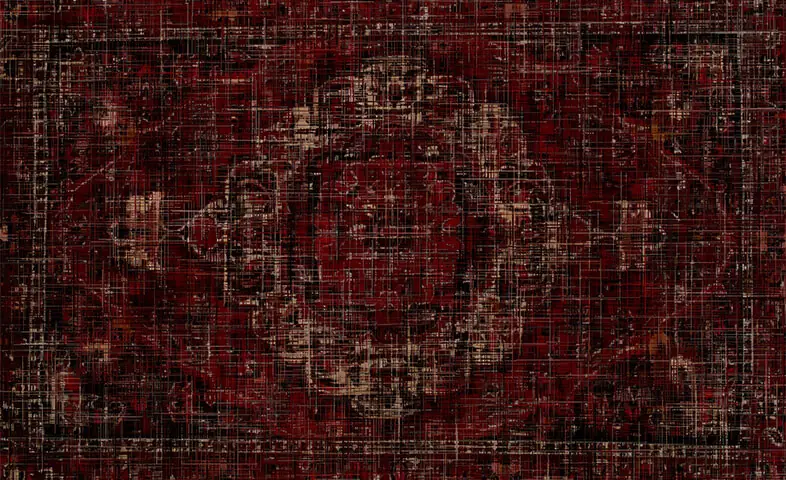
In Basit Iqbal’s artworks, The Ruins We Carry, The Fabric of Absence, Memory Woven in Silence and Every Thread Keeps a Loss, one finds delicately drawn traditional design in black, rust and muted red, giving the feel of a vintage or faded, patterned carpet of Persian style. The distressed texture is effective in establishing an antique or weathered appearance, yet the same design was applied rather uniformly on every canvas, with different literary titles.
The immaculately drawn repetitive design, used to represent an emotional landscape with the visual memory of an old carpet, evokes the feel of displacement, ageing, loss or memory. Overall, the canvases give a nice feeling to look at. At least, the work was neatly displayed.
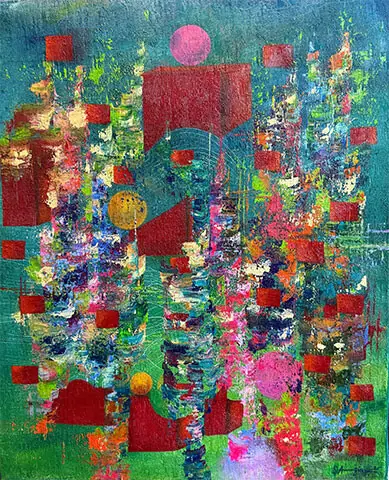
One of Shahrukh Asad’s visually assertive works in the exhibition was a densely layered painting, in which a luminous yellow ground surrounds a fragmented cluster of vertical forms drawn in abstraction. Blues, greens, reds and ochres accumulate across the surface, producing an almost urban setting, in which forms seem to emerge and disappear simultaneously. At the bottom, three simplified geometric structures provide a contrasting sense of solidity, while delicate winged motifs introduce an unexplained symbolic register.
The painting is at its strongest when this tension between fragmentation and structure is allowed to remain unresolved. Yet, the abundance of visual elements also occasionally works against it. The central field becomes congested, while the winged imagery feels insufficiently integrated into the larger pictorial language.
Nonetheless, the work deserves some credit for not yielding its meaning too readily. Its fragmented imagery and ambiguous symbolism invite the viewer to look beyond the obvious and search for connections beneath the surface. The painting does not offer a singular conclusion, instead leaving interpretive space for the viewer to arrive at their own understanding.
‘Visual Intervals’ was on display at Muse Art Gallery in Lahore from August 19-29, 2026
The writer is an art critic, fine artist and educationist based in Lahore. She can be reached at ayeshamajeed2015@gmail.com
Published in Dawn, EOS, September 6th, 2026