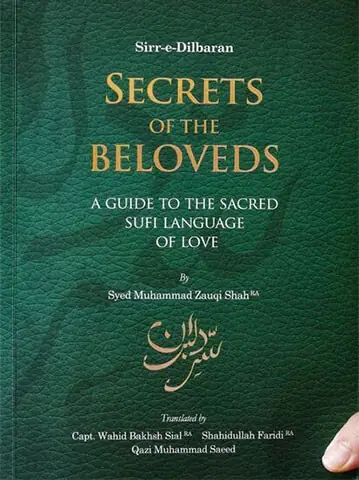
Secrets of the Beloveds: A Guide to the Sacred Sufi Language of Love
By Syed Muhammad Zauqi Shah
Translated by Captain Wahid Bakhsh Sial, Shahidullah Faridi and Qazi Muhammad Saeed
Talifat-e-Shaheedi
ISBN: 978-969-9512-06-3
602pp.
Sufism has developed a lexicon of its own over the centuries. Sufi literature is steeped in symbolism, metaphors and a vocabulary whose meanings go beyond ordinary usage. To enter this literary world is to encounter a rich intellectual and spiritual tradition, in which language becomes a means of describing one’s inner journey and relationship with the Divine.
Persian and Urdu have a considerable body of literature devoted to explaining Sufic vocabulary and exploring the ideas and meanings embedded within it. In English, however, such works remain relatively limited. Secrets of the Beloveds: A Guide to the Sacred Sufi Language of Love aims to fill this gap.
The book is an English translation of the Urdu version, first published in 1951. Syed Muhammad Zauqi Shah wrote the original work and it has now been translated by Captain Wahid Bakhsh Sial, Shahidullah Faridi and Qazi Muhammad Saeed.
In the introduction, the book is described as the first volume of an “encyclopaedia of Islamic spirituality.” However, it is far more than a glossary of mystical expressions. It is, instead, a detailed guide to the language of Sufism. Most of the entries in the book are accompanied by detailed commentary that explores the philosophical and spiritual dimensions of the words, enabling readers to appreciate not only their literal meanings but also their place within the broader Sufi worldview.
An translation of a 1951 book provides a valuable English guide to the vocabulary of Sufism, exploring its mystical concepts and spiritual meanings, especially for those not well-versed in Urdu or Persian
The book is arranged alphabetically. Each letter of the alphabet gets a chapter of its own, with words that begin with that letter. Most of these chapters are also accompanied by explanatory notes at the end, providing further context and clarifications. This structure makes the material easier to understand.
One of the book’s strengths lies in the depth with which it treats individual concepts. Many entries are, in effect, substantial essays rather than brief dictionary definitions.
The depth of these explanations can be seen in the treatment of seemingly ordinary words. Beemari, for instance, ordinarily means sickness or illness, but in Sufi terminology, as the book says, it refers to the “inner pangs of love, the sadness of separation, and the social, moral and spiritual weaknesses that prevent a seeker from progressing towards God’s nearness.”
Similarly, a common word such as guftugoo, which means conversation or talking in Urdu and Persian, takes a mystical meaning. In the terminology of Sufism, the book describes it as “everything that may arouse feelings of love.” Likewise, aahoo in Urdu and Persian ordinarily means a deer. In Sufi vocabulary, however, it is “a human being who leaps like a deer through the valley of Divinity, revelling in the bliss of union with the Divine Beloved.”
The entry on ana, commonly understood as ‘ego’ or ‘I-ness’, is particularly interesting. Here, the book describes a series of deeper layers within the human being: “The human body contains a piece of flesh [that] contains the heart (fuad), which contains the spirit (rooh), which contains the secret (sirr), which contains the hidden (khafi), which contains the hidden most (ikhfa), which contains ana (I-ness). Ana stands for the Pure Essence (Zaat-i-Mutlaq). I-ness (ananiyat) in man is really the echo of Divine ‘I-ness’.”
These examples show why this book is more than a conventional dictionary of Sufi terms. Moreover, the explanations are not presented merely as personal reflections or speculative interpretations. Rather, they are supported by references from the Qur’an and Hadith, where needed.
Alongside these religious sources, the author draws extensively on the works of major Persian and Urdu poets, showing how these concepts have been expressed, interpreted and refined across centuries of literary tradition. And because of that, one can read several fine couplets in Persian and Urdu poetry.
One such couplet, for example, reads as follows:
Mast gashtam az do chashm-i-saqi pemana nosh
Alfiraq ae nang-o-namoos, alwida ae aql-o-hosh
[I got drunk from the two eyes of the wine server
I part from fame and honour; farewell to reason and consciousness]
The result is a book that not only teaches new meanings of words but also familiarises readers with the key beliefs of Sufism and enables them to enjoy poetry as well.
The English translation is particularly valuable because it opens this heritage to readers who may not possess a working knowledge of Urdu or Persian. While translations of Sufi poetry are widely available, comprehensive English works devoted specifically to explaining the language and terminology of Sufism are comparatively uncommon. This volume therefore fills an important gap. It will enable English readers to approach classical Sufi writings with greater confidence and understanding.
Students and researchers of Islamic studies, comparative religion and South Asian literature will surely find it to be a useful reference, while general readers with an interest in spirituality or classical poetry will also benefit from it.
All in all, this translation is an important cultural and intellectual service.
The reviewer is a member of staff. X: @WaqasAliRanjha
Published in Dawn, Books & Authors, September 6th, 2026