


KARACHI: The Pakistan Stock Exchange (PSX) remained under selling pressure for the second straight session, as escalation in the Middle East and an upsurge in crude oil prices have pushed local petroleum prices higher, stoking fears of a rise in inflation and a surge in the cost of production, bringing more pressure on an already stressed economy.
Topline Securities Ltd said the PSX came under pressure as the ongoing US-Iran conflict and elevated international oil prices continued to weigh on investor sentiment. Concerns about the potential impact on inflation, the external account, and Pakistan’s import bill prompted investors to book profits after recent market gains. Selling was particularly evident in index-heavy sectors, keeping the broader market in the red.
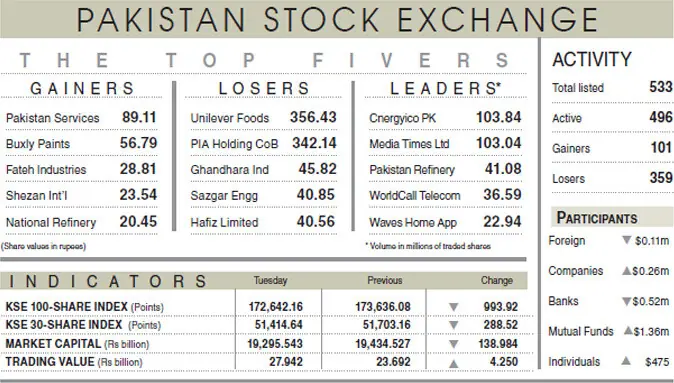
The KSE-100 index fell as much as 2,145 points intraday to 171,490.63 before recovering some of its losses to close at 172,642, down 993.63 points or 0.57 per cent.
United Bank, Lucky Cement, Meezan Bank, National Bank, and Pakistan Petroleum were among the major drags, collectively wiping out 485 points from the index. Conversely, Pakistan Services Ltd, MCB Bank, and Attock Refinery provided some support, collectively adding around 199 points.
In a bearish market, increased investor participation indicates panic selling, with total traded volume rising 6.39pc to 722.6 million shares and traded value up 17.94pc to Rs27.9 billion. Cnergyico PK led in trading volume with 103 million shares.
Arif Habib Ltd (AHL) said that with the latest fall, the index entered the July lows and breached the 200-day moving average, with 79 shares closing lower against 18 gainers.
On the broader economic front, the brokerage cited its survey, which found that 87.5 per cent of respondents expect the State Bank of Pakistan to keep its policy rate unchanged at 11.5pc at the upcoming Monetary Policy Committee meeting on Sept 14, while 12.5pc anticipate a 50-basis-point increase.
“For now, we expect SBP to keep its policy rate unchanged at 11.5pc while keeping its options open as incoming data and the external environment evolve,” AHL said in its note, adding that the direction of the next move would depend on the persistence of external shocks, oil prices and the extent of domestic inflation pass-through.
“The decline that we had been anticipating has now materialised and the KSE-100 has entered into the July lows and the 200-DMA,” the brokerage noted, adding that price action over the coming sessions would determine further directional bias.
Published in Dawn, September 9th, 2026

























