



Prism Reflections: The document doom loop of domicile certificates
There are few tests of a Pakistani citizen’s faith in the state tougher than the quest for a paper proving her child actually exists. It started innocently. My daughter needed a domicile certificate for a college entrance exam. The task seemed simple enough: make a visit to the government office that issues it, hand over the documents, pay the fee, and leave.
Thanks to Google Maps, I made it to the domicile office but couldn’t tell where the information desk was located. I had to ask at several desks before finding it. It was here that I was dutifully informed that one of the documents needed for a domicile certificate was a No-Objection Certificate or NOC. But where does one acquire an NOC? The person sitting at the desk shrugged. That was a mystery for me to solve.
I arrived at the relevant office, armed with everything experience has taught any Pakistani to carry: original documents, photocopies, extra photographs, copies of ID cards, copies of copies, a pen, patience, and the faint hope that the person behind the desk might know the procedure. What followed was nothing short of administrative gymnastics.
Official 1 examined my stack and confidently declared Document A was missing.
Official 2 looked at the exact same stack and insisted Document B was missing.
Official 3 suggested the first two had completely misread the rules.
Official 4 looked at me as if I had misunderstood the concept of government altogether.
Each desk offered a new interpretation of the rules. One required a letter. Another insisted the letter was unnecessary. Someone wanted a verification. Someone else said the verification could only be issued after the NOC, which was useful because I needed the verification to obtain the NOC. All of this was happening as I wandered through the network of courts and associated rooms in the Deputy Commissioner’s Office, in the June heat.
The process, by that point, had achieved a kind of bureaucratic perfection: every document depended upon another document that could not be issued until the first document existed. Ah, a state of pure, impenetrable deadlock. And then came the blessed sentence.
“Madam, chalein kuch kertay hain aap kay maslay kay liyey.” (Madam, let’s try to figure something out).
It was delivered gently, almost compassionately, as though the official was personally taking my daughter’s future under his wing.
At first, I mistook it for old-fashioned public service. How lovely, I thought. A public servant serving the public. But then the phrase reappeared at the next desk. And the next. Each time, it came with a slight lean forward, a lowered voice.
It takes a moment to decode this dialect of national bureaucratic empathy. It’s just the transactional “service charge” rearing its head to grease the wheels. The irony, once I understood, was difficult to miss. For days, the official system had treated the NOC as though it were a document requiring constitutional amendment, inter-provincial consensus, and perhaps approval from the United Nations Security Council. Once the unofficial system took over, the impossible suddenly was very much possible, and might even be hand delivered to my home, if I paid the right fee.
I found myself experiencing an emotion that no citizen should have to feel for routine tasks: gratitude. Files were accepted and signatures appeared on them, ink still wet. Officials mysteriously ‘unavailable’ were suddenly holding the door for me to enter their office. The state, previously paralysed, had somehow developed remarkable reflexes in mere seconds.
Within hours, the NOC was ready.
If only the story ended there.
Alas, the domicile office had changed its documentation requirement overnight. When we visited the following morning, we were informed of the new rules by the new gentleman manning the new information desk. I not only needed a utility bill to prove I was residing at the address I said I was, I also needed to prove that the house belonged to me, and my daughter was in fact my daughter, even though being 18 and having a CNIC makes her an adult.
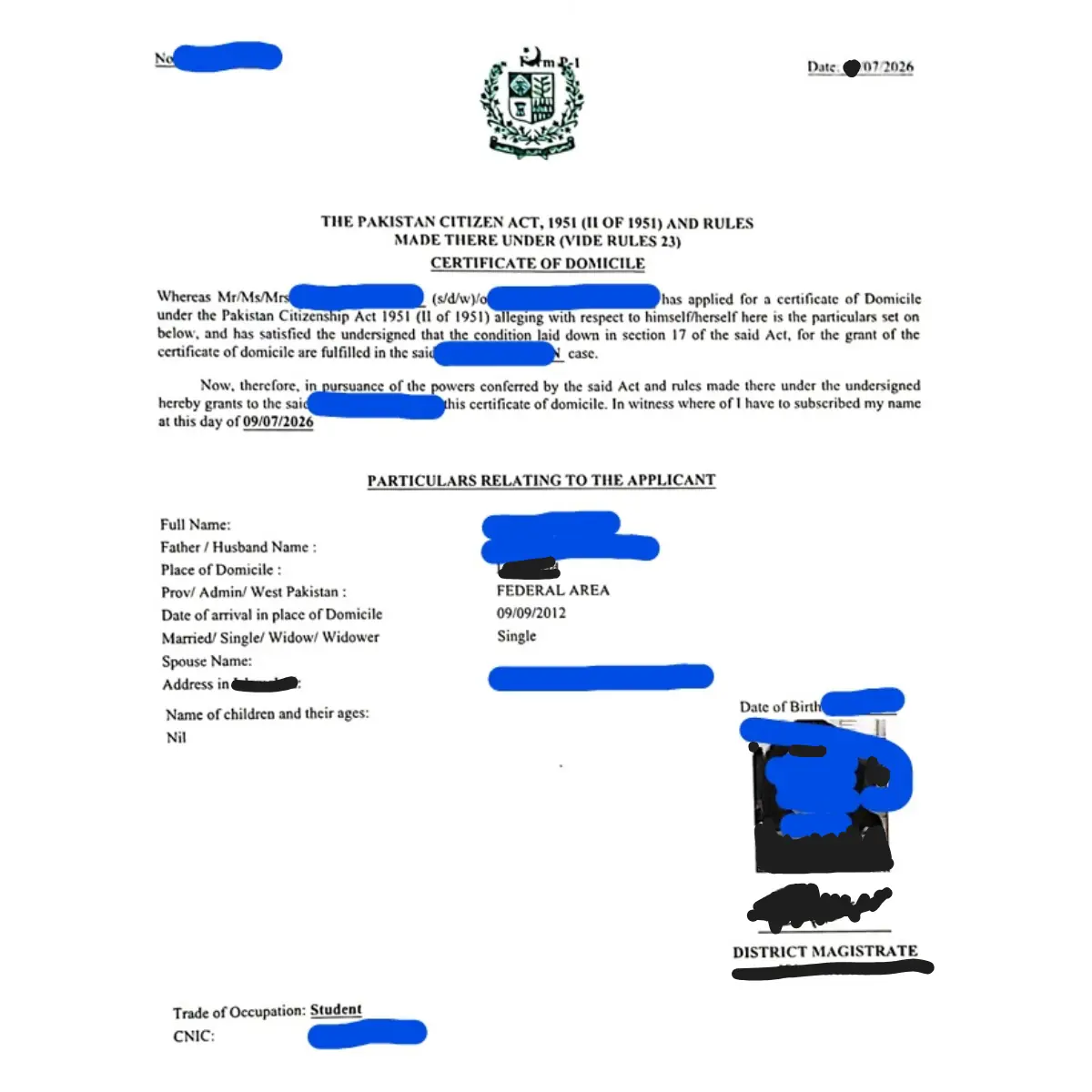
Luckily, my NOC ordeal had already turned my folder into an inch-thick dossier of redundant paperwork. Perhaps the greatest hilarity of the entire debacle was that the domicile itself was issued within, no exaggeration, five minutes, once we submitted the required (and apparently no longer required) documents. My daughter threw her hands up in joy as we were handed the freshly printed paper. After all that running around and stress, we had what we needed.
I wonder why we forget that this is perhaps the most efficient feature of petty corruption. It’s brilliant in its simplicity and execution. It doesn’t directly ask for what it really wants, rather, it engineers the chaos that makes you beg to have it done. It manufactures delay as a first step through multiple documentary requirements, inefficient working hours, and information asymmetry to transform routine public service into a mission to the moon. The citizen is then made to feel fortunate when an official agrees to solve a ‘problem’ the system deliberately created in the first place.
The rewriting of expectations is genius. We stop being surprised by contradictory instructions. We begin budgeting not only for fees, photographs and attestations, but also for the possibility that someone may eventually lean forward and say:
“Madam, chalein kuch kertay hain aap kay maslay kay liyey.”
Prism Reflections is a space for voices and experiences that shape, and are shaped by, Pakistan’s defining news stories. Do you have a personal story that intersects with the news? Send it to prism@dawn.com

