Judicial sympathy cannot override remission law: FCC

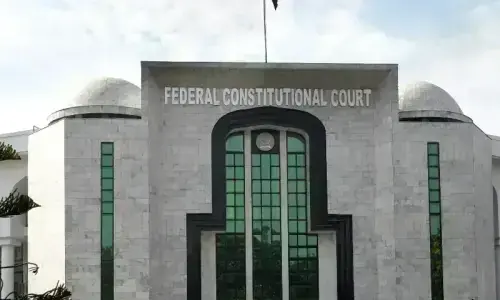
ISLAMABAD: The Federal Constitutional Court (FCC) on Wednesday ruled that judicial sympathy should not be permitted to override statutory commands in cases of excessive remission granted to prisoners.
“Where the sentence relates to an offence punishable with heinous crimes and the legislature has consciously prescribed safeguards to ensure that a sentence of imprisonment for life retains its substantive penal content, judicial sympathy cannot be permitted to override statutory commands,” observed Justice Rozi Khan Barrech.
Justice Barrech was heading a two-judge FCC Branch Registry Quetta bench, also comprising Justice Arshad Hussain Shah, which took up a petition filed by Suba Khan, a life convict, challenging the consolidated judgement of the Balochistan High Court that had declared excessive remissions granted to prisoners illegal and void.
The FCC upheld the BHC judgement.
Upholds BHC verdict declaring excessive remissions to prisoners illegal and void
Suba Khan was convicted by the Loralai additional sessions judge on May 26, 2015, under Section 302 of the Pakistan Penal Code, 1860, and sentenced to life imprisonment with a fine of Rs200,000 and six months’ simple imprisonment in default.
According to the nominal roll submitted by the prison authorities on Aug 17, 2023, Suba Khan had actually undergone nine years, four months and 19 days of imprisonment, while remissions totalling 15 years, seven months and 18 days had been credited to his account. This left only five months and 23 days of imprisonment remaining, subject to payment of compensation.
In a 16-page judgement, Justice Barrech observed that under the legal framework, the remission system was neither absolute nor unregulated.
Not respecting legislative intent would not only undermine the integrity of the sentencing process but also erode public confidence in the fair and lawful administration of criminal justice, the judge observed.
While Rule 199 and Rules 212, 213, 215 and 216 of the Pakistan Prison Rules, 1978, enable prisoners to become eligible for remission through good conduct, industry and appearance in the enlisted examinations, Rule 217 expressly circumscribes the extent to which such remissions may operate.
In the case of a prisoner sentenced to imprisonment for life, Rule 217(ii) unequivocally mandates that the cumulative effect of all remissions should not reduce the actual period of imprisonment to less than 15 years. This statutory restriction is mandatory in nature and admits of no exception, save where the sentence is lawfully altered in the exercise of constitutional or statutory powers by the competent authority, the verdict said.
Applying these principles to the facts of the present case, it is evident that the computation reflected in the nominal roll of petitioner Suba Khan is prima facie inconsistent with the governing statutory scheme.
“Such computation has the practical effect of reducing the petitioner’s actual period of incarceration to substantially below the statutory minimum prescribed by Rule 217(ii) and Rule 140 of the Rules, 1978, thereby defeating the legislative intent underlying the remission framework,” the verdict said.
It said a remission granted or computed in derogation of the express provisions of the Prison Rules cannot confer an enforceable legal right, nor can the FCC lend its imprimatur to an administrative action that travels beyond the authority conferred by law.
“The rule of law demands that executive authorities administer remissions faithfully within the limits prescribed by the legislature,” the judgement said.
It added that there can be no cavil with the proposition that the modern philosophy of punishment recognises reformation and rehabilitation as important objectives of the criminal justice system. The remission regime embodied in the Pakistan Prison Rules, 1978, reflects this reformative approach by creating an incentive-based mechanism through which prisoners may earn reductions in sentence on account of good conduct, industry and educational advancement.
Equally, however, the law maintains a careful balance between the rehabilitative interests of the prisoner and the societal interest in ensuring that judicially imposed sentences retain their deterrent, retributive and denunciatory force.
The verdict observed that the comparative jurisprudence and authorities relied upon affirm that executive clemency and remission must operate within the framework prescribed by law and that the objectives of punishment and public protection must remain paramount.
These decisions reinforce the principle that reformation should be encouraged, but not at the expense of the statutory limits enacted by the legislature, the judgement said.
Published in Dawn, October 1st, 2026