FCC CJ reaffirms commitment to constitutional responsibility

• AGP says FCC rulings have far-reaching implications for outlining state authority
• PBC vice chairman highlights need for constitutional stability
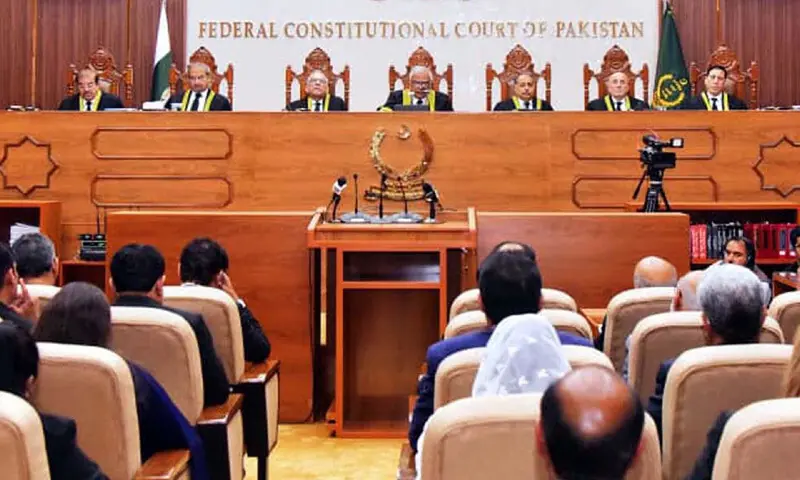
ISLAMABAD: Chief Justice of Federal Constitutional Court (FCC) Aminuddin Khan on Tuesday reaffirmed commitment to constitutional responsibility, judicial independence, transparency and the strengthening of public confidence.
“The Constitution must remain supreme, and every exercise of the public authority must remain within its constitutional boundaries,” he said while addressing at a ceremony held at the FCC to mark the commencement of the New Judicial Year 2026-27.
The FCC chief justice noted that the Constitution was the “supreme expression of the collective will of the people”. He said every institution created under it derived its authority from it and remained subject to its limits. “Therefore, the fundamental philosophy that must guide the court is simple yet profound.”
The FCC was created as part of the judicial restructuring done under the 27th Constitutional Amendment, passed in November 2025. The contentious amendment, passed by Parliament amid the opposition’s outcry, had been criticised by some legal experts as a means of dethroning the Supreme Court as the country’s highest judicial forum, ceding that position to the FCC.
In his remarks, Justice Aminuddin noted that as the FCC was created under the 27th Amendment, it was “required to follow the relevant rules” of the SC until its own regulatory framework could be developed.
The judge described the creation of the FCC as an “important institutional development in the constitutional history of Pakistan”.
He highlighted that constitutional adjudication occupied a “unique position in the administration of justice. It concerns not merely disputes between individuals but questions touching the very structure of the state, the distribution of constitutional powers, the protection of fundamental rights and the preservation of the constitutional order.”
Within a period of around 10 months, he said, significant measures had been undertaken to develop the court’s judicial and administrative framework, frame rules and regulations, establish a new directorate, introduce modern judicial systems, strengthen research and translation functions, and establish registries in all four provinces, with a view to facilitating greater access to constitutional justice.
Referring to the FCC’s expanding international engagement, the CJ highlighted the visits of the president of the Constitutional Court of the Republic of Turkiye, a high-level delegation from Bangladesh, and a delegation of Istanbul Bar Association No 2; participation in the XIV St. Petersburg International Legal Forum; and the admission of the FCC of Pakistan as an Observer to the Conference of Constitutional Jurisdictions of the Turkic World (TURK-AY), describing these developments as significant milestones in the institutional progress. The official FCC-P record uses these titles for the St. Petersburg forum and TÜRK-AY.
The ceremony was attended by other FCC judges, registrar and senior officials; the attorney general for Pakistan; Pakistan Bar Council vice chairman; Supreme Court Bar Association president and other members of the legal fraternity.
Attorney General for Pakistan Mansoor Usman Awan highlighted the significance of FCC’s institutional journey and underscored the importance of effective adjudication of constitutional questions, protection of fundamental rights, use of modern technology, and strengthening of public confidence. He observed that the FCC judgments had far-reaching implications for the interpretation of the Constitution and the delineation of state authority.
PBC Vice Chairman Pir Muhammad Masood Chishti emphasised the importance of constitutional stability, the rule of law, independence of the judiciary, and the prompt and fair administration of justice.
SCBA President Haroonur Rashid expressed the hope that the FCC would continue to play an effective role in upholding the supremacy of the Constitution, reinforcing public confidence.
Published in Dawn, September 16th, 2026