ISLAMABAD: The World Bank on Friday called on the government to expedite the implementation of policy actions under its $20 billion economic reform partnership to harmonise general sales tax (GST), provincial agriculture and property taxes, and remove regulatory constraints to achieve higher growth, revenue mobilisation, and trade and investment facilitation.
The World Bank group launched the 10-year Country Partnership Framework 2025-35 in January last year, with a total blended financing of about $20bn, involving concessionary and commercial lending facilities. It is now pursuing the implementation phase of the agreed reform agenda.
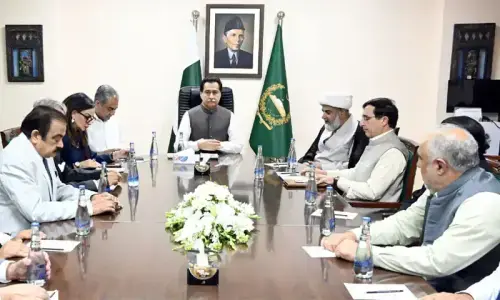
A bank delegation, led by its country director Bolormaa Amgaabazar, met Finance Minister Muhammad Aurangzeb on Friday to review progress under the ongoing economic reform partnership, the Ministry of Finance said in a statement.
The delegation discussed implementation priorities across growth, jobs, fiscal management, revenue mobilisation, capital-market development, trade and investment, and institutional reforms.
Calls to expedite GST, agriculture tax harmonisation under $20bn country partnership framework
According to the finance ministry, the meeting reviewed the World Bank’s support for Pakistan’s broader economic reform agenda, with particular emphasis on translating reform priorities into targeted, implementable actions and strengthening coordination among relevant ministries, provincial governments and implementing agencies.
The two sides agreed to move from reform design to effective implementation, focusing on practical measures that can deliver measurable improvements in economic activity, investment, jobs, and the overall business environment, the statement said.
They discussed the proposed World Bank growth and jobs operation, including interventions aimed at improving the investment climate, access to finance, sectoral productivity and labour-market outcomes.
The World Bank outlined proposed measures to support the investment framework, reduce regulatory and business constraints, improve access to finance for small and medium-sized enterprises (SMEs), and develop export finance products for the EXIM Bank of Pakistan to support incremental trade flows, the statement said.
On sectoral reforms, the World Bank highlighted proposed interventions in pharmaceuticals and medical products, and in agriculture, including improvements to seed registration, deregulation of selected commodities, and strengthening of international accreditations to facilitate participation in international procurement and markets. “The meeting also reviewed initiatives to strengthen skills development and labour-market alignment, including improvements in the national vocational qualifications framework, greater international recognition of skills and development of formal overseas migration pathways supported by digital platforms,” it said.
According to the statement, the finance minister and the World Bank delegation reviewed the implementation of the National Tariff Policy and ongoing analytical support for tariff reforms, including work on the automotive sector and future tariff reforms.
“The discussion emphasised the importance of supporting competitiveness, productivity, investment, exports and Pakistan’s greater integration into global value chains.”
On fiscal and revenue reforms, the meeting reviewed World Bank technical assistance to strengthen tax-policy capacity, including support for the medium-term revenue strategy and revenue-policy modelling, the statement said. It added that discussions also covered general sales tax harmonisation, including greater alignment of rules, definitions and classifications for services, improved federal-provincial coordination and stronger data-sharing arrangements.
The ministry said that the meeting between the two sides also reviewed progress on agricultural income tax reforms, including the implementation of amended provincial laws and rules and of digital systems for registration, filing and payment.
“The importance of strengthening compliance and federal-provincial data sharing was also discussed.”
Published in Dawn, October 3rd, 2026