The writer is a journalist and researcher, who writes for The New York Times and Nikkei Asia, among other publications. He also assesses democratic and conflict development in Pakistan for various policy institutes. He tweets @zalmayzia
For a country battling insurgencies in two provinces, facing a hostile Afghan Taliban regime, and grappling with deep internal divisions, instability in a neighbouring state carries tangible security risks.
Four years on from the Taliban’s return to power in Afghanistan in August 2021, the optimism surrounding what was being hailed as a geopolitical victory for Pakistan has vanished.
Whether negotiations succeed or falter, the people of the tribal belt remain suspended in an uneasy calm, caught between promises of peace and the shadow of war.
Security analysts warn rising threats from Islamist extremists and separatist insurgents present a complex security challenge that cannot be addressed through military action alone.
The APS attack claimed 147 lives in mere hours on Dec 16, 2014, but its impact — documented through the voices of survivors, grieving families, first responders, and a nation still grappling with terrorism — continues to shape Pakistan's struggle for peace a decade later.
Over the past few months, the government's use of the Fourth Schedule has taken a troubling turn, with dozens from KP and Balochistan placed on the list.
Opposition from political parties, peace campaigns, and civil society groups has cast doubt on its efficacy, leaving the public and observers questioning the fate of the operation.
Karachi’s labour uprising serves as a testament to the power of organised labour, in stark contrast to Pakistan’s trade union landscape today. What fed this movement and what led to its downfall?
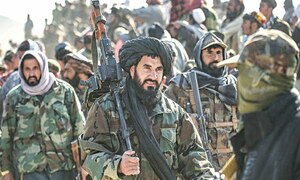
Once lauded as the 'good Taliban' for refraining from carrying out attacks against Pakistan's security forces, Bahadur's group seems to have joined hands with the TTP to launch attacks in KP.