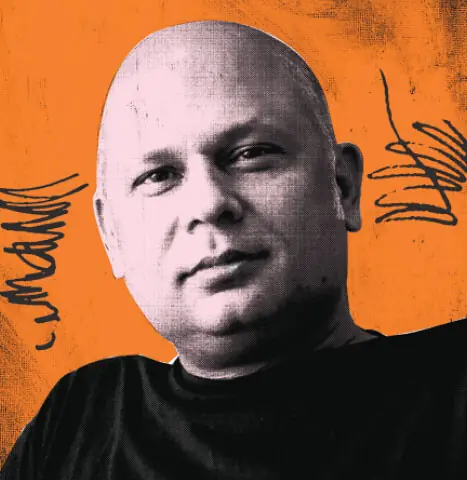
Hassan Blasim is an Iraqi writer whose collections of short stories, The Madman of Freedom Square and The Iraqi Christ, have been translated into English, where they met with wide acclaim. Blasim’s newest project is another collection of stories, but here he operates as editor as well as contributor. Iraq+100: Stories from Another Iraq was conceived as a way to look past the country’s troubled present and recent history by focusing instead on the future. Blasim asked Iraqi fiction writers for stories that answered the question: what might Iraq look like in the year 2103, a hundred years after the US-led invasion and its catastrophic consequences?
Not surprisingly, the stories in this book are wildly diverse, encompassing straight-up science fiction (a rarity in the world of Arabic literature, as Blasim asserts in his introduction), allegory, fantasy and many shades in between. In these pages, there is no shortage of futuristic happenings both wondrous and unsettling: global warming, ethnic purges, domed cities, alien invaders, time-travel and tiger-droids (whatever those are). We read of the coming Arabic renaissance, and of the rejection of all religion. In some of these visions, the lack of resources leads to looting and riots. Elsewhere, human beings themselves are raised as meat. It is fair to say that few of these visions are particularly optimistic, although some do carry with them a kind of grim humour.
Everywhere is the lingering echo of war. The writers may have been invited to look past the present in imagining their country’s future, but very few are able to entirely cast off the shroud of conflict. Even the titles of some of the stories evoke images of conflict: ‘The Corporal,’ ‘Baghdad Syndrome,’ ‘Operation Daniel,’ ‘The Here and Now Prison.’ The Iraq of the 22nd century may no longer be an active war zone, but in these pages, at least, its populace is still largely preoccupied with war.
The stories range from six to 26 pages, with Hassan Abdulrazzak’s ‘Kuszib’ being among the longest and the most memorable. Abdulrazzak incorporates a breezy style that grows increasingly at odds with its disturbing subject matter: the story’s first sentence reads, “Ur was super-excited.” The childlike enthusiasm expressed in this opening gradually gives way to a tale of invasion, enslavement and slaughter, one that operates on levels both fantastical and didactic. By the time the story arrives at its last, shattering line, the reader has undergone an ordeal that, ironically, mirrors that of the main character, but is also far darker.
All of the stories here are worth a look, but ‘Kuszib’ is by far the most emotionally wrenching, at least (and this is an important caveat) for a non-Iraqi such as myself. There is no shortage of rage and despair in these pages, but these are feelings that are most naturally going to be evoked by citizens of what these stories might refer to as what used to be Iraq. The narrator of ‘Baghdad Syndrome,’ an architect who is tasked with the reconstruction of a public space known as Lovers Square, exudes melancholy as she dreams of her city, “wandering the streets of a city that appears to be Baghdad.”

The other long piece in the collection, Ali Bader’s ‘The Corporal,’ relates the story of an Iraqi officer who is killed in 2003 by an American soldier, only to find himself reanimated a hundred years after his death, strolling through a future Baghdad where the streets have been renamed and citizens fret about “extremist states.” That would be America, for as the narrator is told by an excited passerby, Iran and Saudi Arabia “are now the vanguard of the civilised world, just like Iraq […]. The West […] has been transformed into an oasis of terrorism, a haven for religious intolerance and hatred.” The satire here is not particularly subtle, but its power grows out of the long passages that precede it, which recount the dead narrator’s pointless death in tragic detail.
A word must be said about these translations which are uniformly lively and readable. All but two of the stories are translated from Arabic and the results are impressive. (‘Kuszib’ claims no translator, suggesting that it was written originally in English, which may be one reason why it is a particular standout.) Translators rarely get the credit they deserve, but this collection of dedicated professionals should be publicly acknowledged for their efforts.
This is a short collection, whose 10 stories fill about 200 pages. A companion volume would be most welcome. Certainly there are more stories to tell about the future — of Iraq, of the human race. Surely there must be an infinity of them. This is a good start, to be sure, but let’s hope it is only a start.
The reviewer is the author of five novels, including
The Preservationist and Fallen
Iraq + 100: Stories from Another Iraq
Edited by Hassan Blasim
Carcanet Press, UK
ISBN: 978-1905583669
224pp.
Published in Dawn, Books & Authors, April 16th, 2017