
KARACHI: Highlighting high levels of lead concentration in roadside dust and plants and its harmful impact on health and environment, a recent study has described battery recycling workshops as a major contributor to environmental lead and suggested their removal from densely-populated areas.
Titled Lead concentration in urban dust and leaves of street plants, Karachi, the study was jointly conducted by the Institute of Environmental Studies (IES), Karachi University, and Pakistan Council of Scientific and Industrial Research (PCSIR).
Hassan Farid, a researcher at the IES, carried out the study under Prof Zafar Iqbal Shams of the IES and Dr Farooq Ahmed Khan of the PCSIR.
The study found varying levels of lead concentration in dust and roadside plants from 29 city areas including Aziz Bhatti Park in Gulshan-i-Iqbal, Quaid-i-Azam mausoleum, Tariq Road, Commissioner’s Office in Saddar, Sindhi Muslim Housing Society, Soldier Bazaar, Denso Hall, Jama Cloth Market on M.A. Jinnah Road, Finance and Trade Centre on Sharea Faisal and Merewether Tower.
Highest concentration of lead in dust was found in Nazimabad No. 2
According to the study’s findings, the highest concentration of lead in dust was found in Nazimabad No. 2, followed by Pakistan Quarters and Tibet Centre, whereas the lowest lead concentration in dust was found along Shahrah-i-Liaquat.
The highest concentration of lead was found in the leaves of Conocarpus erectus at Dak Khana, Liaquatabad, while the lowest concentration was found in the leaves of Guaiacum officinale (lignum) at Quaid’s mausoleum.
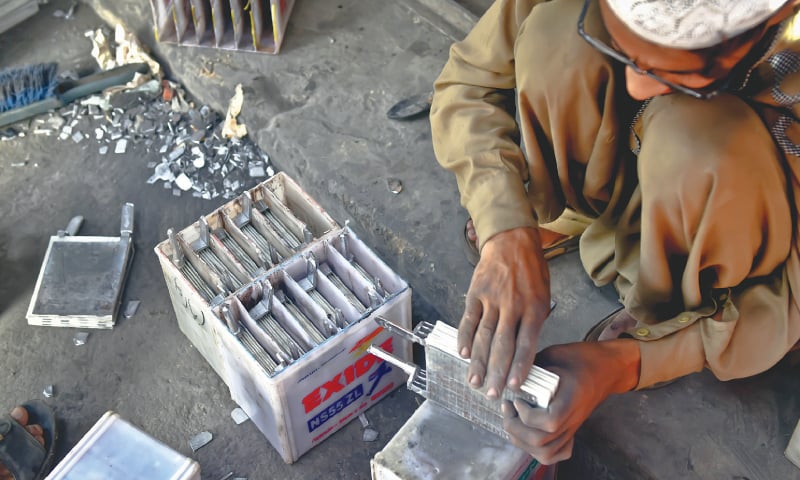
According to the study, the main source of lead in the dust at designated sites seems to be the roadside workshops for welding and soldering, particularly recycling shops of lead-acid batteries. The used lead-acid batteries of motor vehicles are generally recycled and repaired in shops along busy streets of inner-city areas.
“Due to continued electricity shortages in Karachi over the past few years, demand for recycled batteries, often used in uninterrupted power supply (UPS) systems, has increased dramatically. Inner-city areas have over 1,000 recycling shops of used lead-acid batteries,” it says.
These shops, according to the study, are located in densely-populated areas and contributing to environmental lead, suggesting that the work should be transferred to factories, where batteries are manufactured, for their proper recycling and proper disposal.
It also highlights the adverse impact exposure to lead could have on human health and points out that urban dust is an important pathway that increases blood lead level (BLL) particularly in young children. “Blood lead level in children living in Karachi has been studied over the past few years which demonstrate that children are currently exposed to high level of environmental lead,” it says.
According to the World Health Organisation, lead is a cumulative toxicant that affects multiple body systems and is harmful to young children. “Young children are particularly vulnerable to the toxic effects of lead and can suffer profound and permanent adverse health effects, particularly affecting the development of the brain and nervous system. Lead also causes long-term harm in adults, including increased risk of high blood pressure and kidney damage. Exposure of pregnant women to high levels of lead can cause miscarriage, stillbirth, premature birth and low birth weight, as well as minor malformations,” the WHO website says.
Published in Dawn, June 13th, 2017