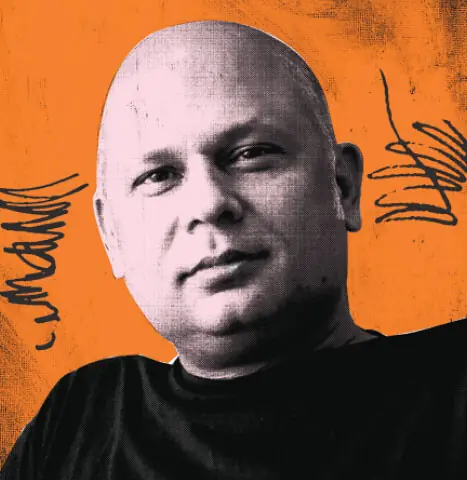
If what was reported in this newspaper a few weeks ago regarding Mohsin Hamid speaking at an event in Lahore is correct, it certainly warrants some attention. Perhaps not just because Hamid expressed these opinions, but more so because these ideas are regularly endorsed and publicised by other influential authors, commentators and readers who are only capable of appreciating what is said or written in English, yet comment on the entire linguistic landscape and literary corpus of Pakistan. Hamid had reportedly said that Pakistanis who need additional identities for themselves as either Muslims, or as Sindhis, Punjabis, Baloch or Pakhtun, do so because they don’t believe in themselves. He also said, perhaps in response to another question, that there are few English-language writers from Pakistan despite having a rich literary history. But, according to him, that deficit seems to be ending as more and more young people are learning the English language and trying their hand at story-writing.
Before I contest the two points mentioned above I should confess my admiration for Hamid’s debut novel, Moth Smoke. I thoroughly enjoyed its feel, coherence, familiarity and rusticity. However, after initial success and becoming part of the large international fiction publishing industry, it remains a challenge for most writers from the Third World not to consciously or unconsciously respond to the gaze they find themselves in. It is the literary agent, publisher, reviewer and bookseller of the West who has a definite impact on both the choice of themes and the treatment of language. One must acknowledge, though, that Third World writers continue to push these boundaries placed around them as much as their individual sensibility and literary talent permit.
Now, let’s come to the question of the absence of self-belief among our people who seek identities other than being Pakistani. There is a fundamental difference between those who portray being Muslim as their primary identity and those who emphasise the recognition of their ethno-lingual identity of being Sindhi, Punjabi, Baloch, Seraiki, Gilgiti, Gujarati, Bihari, Hazara or Pakhtun. Being only Muslim was the identity encouraged by the Pakistani state establishment, which, in fact, propagated that being Pakistani and being Muslim were mutually interchangeable. Powers that be promoted this ideology to the extent that people forgot their national and territorial moorings and psychologically became part of an abstract Ummah.
Therefore, it is important to remember that those who want us now to become Pakistani first and last, wanted us to become Muslim first and last until a few years ago. But being conscious of one’s ethnicity and language in Pakistan is about the assertion of cultural and linguistic rights, economic and social freedoms, and civil and political entitlements within a regressive polity. To see these people as lacking self-belief is itself reflective of a lack of a sense of political history and a limited interest in knowing about cultural rights movements in the face of denial and oppression by dominant groups and institutions.
Likewise, it is hugely problematic to hold the view that there are few English writers from Pakistan despite us having a rich literary history and that this ‘deficit’ now seems to be ending because more young people are learning the English language. As much as one loves to read and write in English and cherishes what it offers, how can we forget that the rich literary history we have is not in English? Subsequently, there is no deficit or dearth of exceptionally good writers in our languages rooted in our literary tradition — from Sindhi and Urdu to Punjabi and Pashto, etc. Sometimes it feels that the way Urdu was once used to impose a unitary nationhood, discouraging diversity and denying the rights of other native languages, English is now being promoted to impose a unity on our literary and intellectual idiom, our ways of thinking and our means of expression.
The writer is a poet and essayist based in Islamabad. His collection of essays Crimson Papers: Reflections on Struggle, Suffering, and Creativity in Pakistan was recently published by Oxford University Press
Published in Dawn, Books & Authors, June 25th, 2017