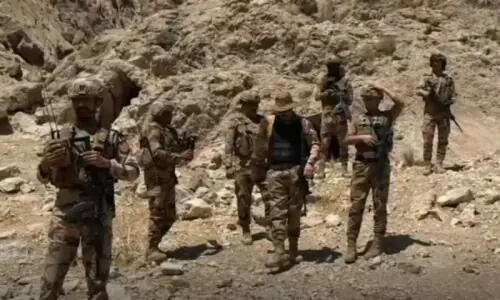
WITH the launch of Operation Khyber-4, the military will attempt to address a long-standing problem that has evolved in an unexpected way more recently. A fourth iteration of the same exercise may give the impression of unfinished counter-insurgency operations, but the Rajgal Valley, in the Tirah region of Khyber Agency, is a roughly 250-square kilometre impenetrable zone. Earlier Khyber operations had given security forces the control of peaks surrounding the valley and from there, when militant activity was detected, it was possible to use artillery or even aerial firepower. On the other side of the border, across from Rajgal Valley, lies the militancy-infested eastern Afghanistan, with familiar names such as Tora Bora and Achin. Anti-Pakistan militant groups, such as the Mangal Bagh network Lashkar-i-Islam, had found sanctuary in eastern Afghanistan and crossed over into Pakistan through Rajgal Valley for terrorist operations here.
What appears to have changed is that the militancy dynamic in eastern Afghanistan has shifted in favour of the militant Islamic State group; it has elevated the danger that Pakistan faces through the Rajgal Valley route. So now the military has freed up forces to take the fight to militants inside the valley and, eventually, set up posts along the border from where future militant movements can be interdicted. It will be a tough fight and Pakistan’s brave soldiers will incur losses. Their sacrifices for the long-term security of the country are the backbone of the nation’s resolve. It remains to be seen if the Afghan government will be able to provide some support to the Pakistani effort. What is needed is a hammer-and-anvil approach that leaves the militants no space to escape or operate. Pakistan has acted sensibly by informing the Afghan government in advance of the operation, and bilateral relations are not as openly rancorous as they were until recently. Perhaps there will be space for some trust-building joint efforts along the border.
There remains a fundamental reason for Pakistan and Afghanistan to cooperate in this latest phase of a long war against militancy. The Afghan security forces, assisted by American firepower and a smattering of ground forces, have inflicted significant blows on the fledgling IS network in Afghanistan. IS is a serious threat to Pakistan too, hence the latest operation in Khyber. The new US administration, which is expected to unveil a new, so-called South Asia strategy soon, has made fighting IS the centrepiece of its security policy. Surely, all sides can find a way to cooperate in the circumstances.
Published in Dawn, July 17th, 2017