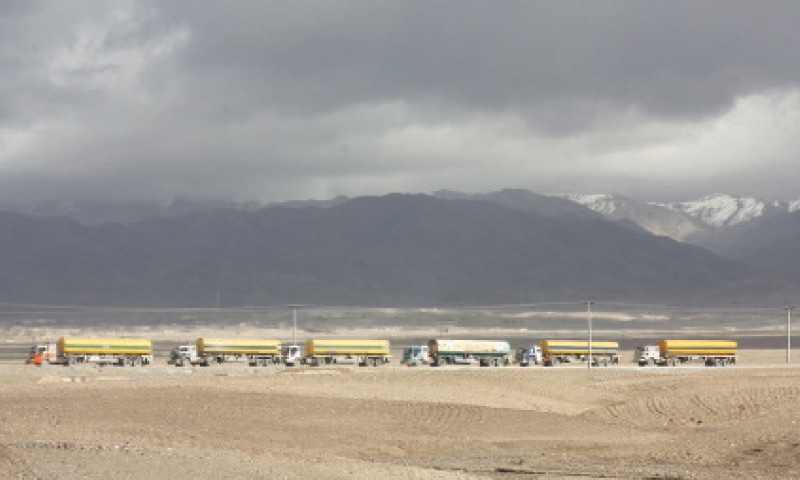

KARACHI: The country needs to minimise oil supply via road and move towards pipeline transportation in the long term, and in the meantime the government must ensure existing vehicles comply with necessary safety standards, an official of the Oil Companies Advisory Council (OCAC) said.
“Pipeline is the cheapest, safest and securest mode of [petrol, oil and lubricants] POL transportation, but Pakistan has not been able to transform this advantage to its own benefit,” OCAC Chief Executive Officer Ilyas Fazil said in a conversation with Dawn.
As per the OCAC, transporting oil by road costs Rs2,628 per tonne compared to Rs792 per tonne via pipeline.
The primary means of transportation to oil depots/installations right now is by road but this needs to change in the long run, Mr Fazil said.
“This means transporting oil through pipeline to the installations and depots. Thereafter, the secondary transport – to retail outlets – will necessarily still be by road but the majority volumes would have been transferred via pipeline,” the official explained.
OCAC chief executive says existing road tankers must comply with safety standards
Around 61 per cent of POL transport in Pakistan is being done via road, pipeline accounts for only 37pc while the remaining 2pc is done by the railways.
Over 12,000 road tankers are being used for transporting petroleum products.
Transportation of petroleum products by road has its myriad challenges, the OCAC official said.
Transport by road entails vehicle management (ensuring that vehicles meet the required safety standards in their manufacture), journey management (ensuring that the drivers are not only capable and trained in such transport but also adherence to safety measures (such as minimum two drivers for a trip, rest periods during long-haul transport from Karachi to up-country destinations), and meeting the National Highway Authority (NHA) axle-load and maximum weight protocols.
The OCAC official said that it is a challenge both for the industry as well as the Oil and Gas Regulatory Authority (Ogra). This needs to be tackled in a rational, logical manner to ensure that non-compliant vehicles are phased out and that full-fleet compliance to the transport standards is achieved within a minimum reasonable time-frame and that all stakeholders (from the vehicle owners, contractors, OMCs and Ogra) are committed to the agreed time frame, he stressed.
The demand of petrol in Pakistan is expected to grow by over nine million tonnes by 2012-21 while diesel demand would reach 12.5m tonnes.
Refineries produced 1.838m tonnes of petrol in 2016-17 as compared to 1.589m tones in 2015-16.
Production of high-speed diesel rose to 4.574m tonnes in 2016-17 from 4.381m tonnes in 2015-16.
Import of petrol swelled to 6.72m tonnes in 2016-17 which included RON 87, 92, 95 and 97 while in 2015-2017 import stood at 4.142m tonnes of only RON 92 petrol.
Increase in sales of locally produced cars and two wheelers as well as thriving imports of used cars is contributing to burgeoning demand of petrol. Besides, higher imports of power generators and consumers’ shift towards petrol from CNG due to lower price has also boosted demand.
Import of diesel stood at 3.89m tonnes in 2016-17 as compared to 3.082m tonnes in 2015-16. Increasing sales of locally produced heavy vehicles and arrival of used trucks and new buses followed by rising imports of diesel generators created extra demand for diesel.
Import of power generating machines had surged by 64pc to three billion dollars in 2016-17 from $1.8bn in 2015-16.
However, this phenomenal growth potential does not account for the volumes that the China-Pakistan Economic Corridor would add to the POL requirements, Mr Fazil said.
There will be enough petrol and diesel volumes to go around for all stakeholders — the OMCs, the transporters (pipeline and road) and the tanker manufacturers, he explained.
He stressed that the OCAC is closely working with Ogra to arrive at a consensus in collaboration with all stakeholders and the Ministry of Petroleum and Natural Resources in ensuring that this task is achieved in the shortest possible time and addresses the short-, medium- and long-term plans needed in this regard.
He said the annual capacity of the White Oil Pipeline (WOPP) — which originates at Karachi and traverses 860km to mid-country — is 8m tonnes and it is capable of doubling this with drag reducers and additional pumping stations. Its current utilisation is around four million tonnes.
Parco/Papco, owner of WOPP, is already working on making their pipeline system suitable for handling petrol in addition to diesel.
Following the Ahmedpur East tragedy in June this year, Ogra estimated that up to 85pc of all tanker lorries transporting oil products are not complying with its prescribed safety standards.
The disaster in Ahmedpur East occurred when a tanker carrying 40,000 litres of fuel overturned after trying to make a sharp turn while travelling from Karachi to Vehari on the main highway. Hundreds of residents of a nearby village gathered to collect the leaking fuel. The subsequent inferno led to the loss of 214 lives.
Published in Dawn, September 5th, 2017