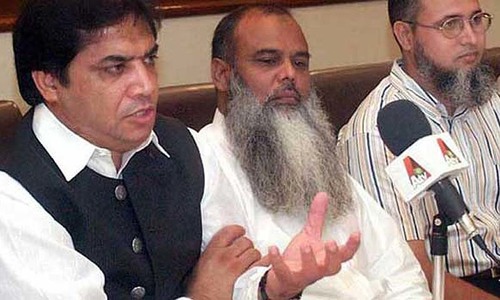
The counsel representing PML-N leader Hanif Abbasi alleged on Wednesday that the documents submitted by PTI leader Jahangir Tareen in the Supreme Court concerning 18,500 acres of contracted land were forged.
A three-member bench of the apex court — headed by Chief Justice Saqib Nisar and comprising Justice Umar Ata Bandial and Justice Faisal Arab — was hearing a petition filed by Abbasi, which seeks the disqualification of PTI chief Imran Khan as well as Tareen over the alleged non-disclosure of assets, existence of offshore companies, as well as receiving foreign funding for their party.
During Wednesday's hearing, as he continued his arguments before the bench, Abbasi's lawyer, Azid Nafees, argued before the court that the PTI leader has adopted varying positions regarding the aggregate agricultural income he declared in his 2013 nomination papers.
He said that, in a written response submitted in the court, the PTI leader adopted the stance that he was not liable to pay tax on the contracted land. Later, the position was adopted that there was no column on the nomination papers for Tareen to declare the income he earned from the land.
"The documents regarding the contract are fake," Abbasi's lawyer alleged.
"Jahangir Tareen did not pay any tax on his agricultural income," the lawyer further told the court. "The leased land is not registered with the Department of Finance," he added.
"Registering the land was the land owner's responsibility," Justice Arab said.
"If Tareen was paying such a large sum for the land, he should have had it registered," the lawyer argued.
"We will have to see if the documents presented by Tareen prove dishonesty," the chief justice said.
Trust deed
Completing his arguments regarding the contracted land, Abbasi's lawyer shifted his attention to a trust through which Tareen had bought property in Britain.
The lawyer recalled that Tareen, in a response submitted to the court earlier, had said that his children are the actual beneficiaries of the trust, not him. However, the lawyer argued, according to the trust deed submitted before the court, Tareen is the beneficiary of the trust, along with his wife and children.
The lawyer further argued that the trust was established to conceal the ownership of property.
"Are you trying to say that Tareen should have declared the trust in his nomination papers?" the chief justice asked. "The property bought through the trust belongs to the trust," he said.
He added that Tareen, as the settler of the trust, could not have been the owner of the property.
"The trust is a legal entity, the property bought through the trust will belong to the trust," the chief justice said.
When the lawyer told the court that Tareen was required to declare his assets in the nomination papers, the chief justice told him that the trust is not an asset.
"The trust was established in a legal way, where is the dishonesty?" the chief justice asked.
Advocate Nafees then reminded the court that in the Panama Papers case ─ in which former prime minister Nawaz Sharif was disqualified ─ the court had to look at the facts to determine whether the lawmaker was sadiq and ameen as per Article 62 and 63 of the Constitution.
He added that in the present case, the court has to look for dishonesty in a lawmaker's conduct, not intention.
PTI's arguments
After Adovcate Nafees completed his arguments, Tareen's lawyer, Advocate Mohmand Bashir, told the court that his client is not the beneficial owner of the trust.
"Being a beneficiary does not prove that one is the beneficial owner," the chief justice agreed.
"The owner of the trust's funds is the trust," Advocate Bashir said.
"There is hope of receiving something from a trust. There is no column in the nomination to declare what is expected," the lawyer argued.
Justice Bandial retorted that perhaps this was the same as income that has not been received yet, recalling the grounds of Nawaz Sharif's disqualification.
The former prime minister had been disqualified from office for not having declared an iqama (work permit) that entitled him to a salary of 10,000 dirhams while he served as chairman of the board of a Dubai-based company.
The former premier's counsel had argued at the time that Sharif never withdrew the salary. However, Sharif was disqualified for not having declared what the court ruled was a receivable asset.