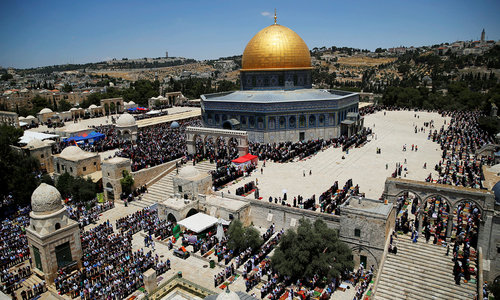
Trump flouts warnings, recognises Jerusalem as Israel's capital



In a much controversial move, US President Donald Trump on Wednesday recognised the disputed city of Jerusalem as the Israeli capital and announced to shift the US embassy from Tel Aviv to Jerusalem.
“I have determined that it is time to officially recognise Jerusalem as the capital of Israel,” the US leader said in a speech from the White House. “It's the right thing to do.”
US President Trump announced his decision amid severe global criticism and warnings that the move would jeopardise the regional peace and create unrest among the Muslim block of the world.
He said his decision marked the start of a “new approach” to solving the thorny conflict between Israel and the Palestinians. Trump also for the first time personally endorsed the concept of a “two-state solution” for Israel and the Palestinians, provided both sides agree to it.

“This is nothing more or less than the recognition of reality,” he said in a White House address, calling it “overdue” and in the best interests of the United States.
The US president maintained that his decision would not compromise the city's geographic and political borders, which will still be determined by Israel and the Palestinians.
Read: Trump’s decision on Jerusalem reflects the influence of powerful allies in his inner circle
Since 1995 it has been the US law that Washington's embassy in Israel must be moved from Tel Aviv to Jerusalem, as demanded by the Jewish state. But every six months since the law was passed, a succession of US presidents have signed a waiver to hold off on a switch.
Trump's announcement plunges the United States into a decades-long dispute over a city considered holy by Jews, Muslims and Christians, and flies in the face of warnings from US allies and leaders across the Middle East.
The US president was expected to stop short of moving the embassy to Jerusalem outright — a central campaign pledge which his administration has postponed once already. Trump was due to decide the matter on last Monday but his administration decided to delay the move till today, probably because of global criticism.
So far, all foreign embassies are located in Tel Aviv with consular representation in Jerusalem. The status of Jerusalem is a key issue in the Israeli-Palestinian conflict, with both Israelis and Palestinians claiming the city as their capital.
Ahead of Trump's speech, Arab and Muslim leaders spoke about the potential for violence. In Gaza, hundreds of Palestinian protesters burned American and Israeli flags. They also waved Palestinian flags and banners proclaiming Jerusalem as their “eternal capital,” language that Israelis similarly use for their nation.
Even America's closest allies in Europe questioned the wisdom of Trump's radical departure from the past US position, which was studiously neutral over the sovereignty of the city.
Three 'days of rage'
Moving the US embassy will probably take years to implement, but the repercussions of Trump's decision are likely to be swift.
Hundreds of Palestinians burned US and Israeli flags as well as pictures of Trump in the Gaza Strip, while relatively small clashes erupted near the flashpoint West Bank city of Hebron.
Explore: Jerusalem — city of prayer and conflict
The Palestinian armed movement Hamas has threatened to launch a new "intifada," or uprising. Palestinians called for three days of protests — or "days of rage" — starting on Wednesday.
Anticipating protests, US government officials and their families were ordered to avoid Jerusalem's Old City and the West Bank, though the situation remained largely calm on Wednesday.
Turkish President Recep Tayyip Erdogan called for a summit of the Organisation of Islamic Cooperation (OIC), the main pan-Islamic body, in Istanbul on December 13 "to display joint action among Islamic countries" over Jerusalem.
"Such a step will only play into the hands of terror groups," Erdogan said at a joint news conference in Ankara after talks with Jordan's King Abdullah II. Jordan and the Palestinians also called for an emergency meeting of the Arab League in Cairo.