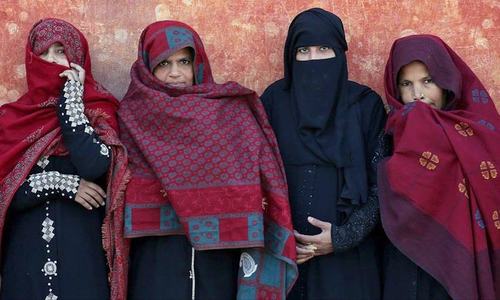
Indian Prime Minister Narendra Modi on Sunday said that his government has removed the restriction on Muslim women from performing Haj alone, following which hundreds of women have applied to travel alone for the pilgrimage, Times of India reported.
Modi, during his monthly radio address of 'Mann ki baat', termed the policy of allowing Muslim women to perform Haj only in the company of a male guardian as "injustice", saying that the removal of the restriction of having a male guardian or 'mahram' may appear as a "small thing", but such issues "have a far reaching impact on our image as a society".
Times of India reported Modi as saying that when he first heard of the restriction, he was surprised as to who would have drafted such a rule.
"Why this discrimination? And when I went into the depth of the matter, I was surprised to find that even after 70 years of our independence, we were the ones who had imposed these restrictions. For decades, injustice was being rendered to Muslim women but there was no discussion on it," he was quoted as saying in his broadcast.
In October, it was announced that Indian women over the age of 45 and travelling in groups of four will be able to go for the annual Haj pilgrimage without a male guardian next year, if the government adopts proposed reforms.
Read: Women and Haj
"Usually there is a lottery system for selection of Haj pilgrims but I would like that single women pilgrims should be excluded from this lottery system and they should be given a chance as a special category," he said.
India's PM also delivered his inaugural address for the 85th Sivagiri Pilgrimage Celebrations via video conference, during which he brought up the issue of instant triple talaq — a practice that allows men to divorce their wives instantly. Modi, according to Hindustan Times, said that after “years of suffering”, Muslim women have finally found a way out to “free” themselves from the practice.
India's top court in August had struck down the controversial practice by a 3:2 majority, deeming it "unconstitutional". Months after the Indian Supreme Court's ruling, the country's lower house of parliament on Thursday approved a bill making the practice illegal and punishable.
Several opposition parties criticised Modi's government for not discussing the legislation with them before introducing it in parliament. The approved bill will now go to the upper house of parliament, where it needs approval before it becomes law.
More than 20 Muslim countries, including Pakistan and Bangladesh, have banned the practice. But in India, the practice has continued with the protection of laws that allow Muslim, Christian and Hindu communities to follow religious law in matters like marriage, divorce, inheritance and adoption.