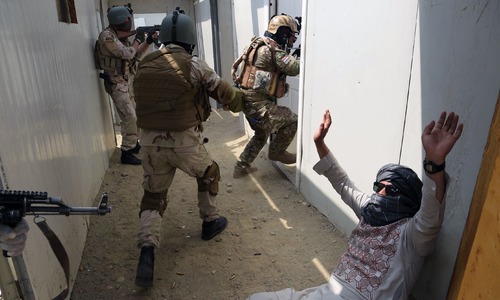
KABUL: Afghan officials are carrying out at least two tracks of talks with the Taliban, it has been learned, even after a month of brutal bombings and attacks by the militants that killed nearly 200 and despite US President Donald Trump’s angry rejection of any negotiations for now.
The persistence of the back-channel contacts reflects the desire to keep a door open for reconciliation even as the Afghan government and its top ally, the United States, fumble for a strategy to end the protracted war, now entering its 17th year. Rifts within the Afghan government have grown vast, even as the Taliban gain territory and wage increasingly ruthless tactics.
The United States has unleashed heavier air power against the Taliban and other militants. After the string of Taliban attacks in recent weeks, Trump angrily condemned the group. “We don’t want to talk with the Taliban,” he said. “There may be a time but it’s going to be a long time.”
Still, Afghanistan’s intelligence chief Masoom Stanikzai and its National Security Chief Mohammed Hanif Atmar continue to each talk separately to the Taliban, say those familiar with the backdoor negotiations. The problem, however, is that neither is talking to the other or to the High Peace Council, which was created by the government to talk peace with the Taliban, they said, speaking on condition of anonymity to discuss the contacts.
Hakim Mujahid, a member of the High Peace Council, confirmed that Stanikzai still has regular contacts with the Taliban’s point man for peace talks, Mullah Abbas Stanikzai. The two are not related.
Mujahid said the group would not respond well to Trump’s tough talk. “The language of power, the language of threat will not convince Afghans to surrender,” he said.
Andrew Wilder, vice president of the Asia Programme at the US Institute of Peace, said multiple players in Kabul have contacts with the Taliban. “But this isn’t being done in a coordinated manner to achieve clearly defined objectives,” he said.
Later this month, representatives from dozens of countries are to meet for a second time in the Afghan capital for the so-called Kabul process aimed at forging a path to peace. The first round was held in June.
Still, the latest spate of violence has limited options for Afghan President Ashraf Ghani, who is also fending off a mini-revolt within his own government, feuding with the vice president as well as a powerful northern governor.
Meanwhile, the former No. 2 of the Taliban, Aga Jan Motasim, who still counts the radical religious movement’s leader Mullah Habaitullah Akhunzada among his friends, warned that Trump’s strategy of using the military to force a more compliant Taliban to the negotiation table could lead to more suicide attacks.
Published in Dawn, February 14th, 2018