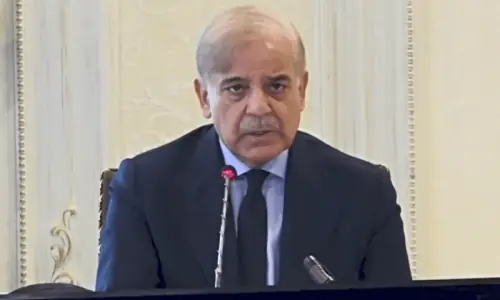
ISLAMABAD: Defence Minister Khurram Dastgir on Wednesday said India had not only wasted the opportunity for normalisation of ties with Pakistan, but was also restricting space for peace lobby through its aggressive anti-Pakistan rhetoric.
The defence minister, while making a policy statement in the Senate on defence policy, said: “The unremittingly hostile, anti-Pakistan stance by the current Indian government has drastically reduced the space for any advocacy of peace.”
The statement was made a couple of days after Indian Defence Minister Nirmala Sitharaman threatened to make Pakistan pay for the militant attack on a military camp in Sunjuwan in India-held Kashmir which left six soldiers and a civilian dead.
Although strains in Pakistan-India ties and New Delhi’s hostile posture towards Islamabad aren’t new, anti-Pakistan bashing touched new levels under the Modi government and became increasingly vitriolic over the years. The Indian government used the rhetoric to appease its hardline constituents at home and internationally keep the pressure on the neighbour.
Pakistan bashing in statements by Indian leaders was, meanwhile, accompanied by escalation in ceasefire violations along the Line of Control and the Working Boundary.
Last year, the highest number of violations in a year — 1881 — were recorded since the understanding on ceasefire went into effect in 2003, resulting in the killing of 87 civilians and soldiers. The pattern has continued this year and there have been more than 200 violations in the first six weeks of 2018 in which around 14 people have lost their lives.
“The escalation in Indian bombings on the Line of Control has been matched with escalation in anti-Pakistan rhetoric, which often descends into baiting and bashing,” the defence minister recalled.
Mr Dastgir noted that Indian government also wasted the opportunity for making peace at a time when a political consensus existed within Pakistan for improving relations with India. He further pointed towards India’s Cold Start Doctrine, massive military build-up, and change in wartime and peace deployments as a proof of Delhi’s hostile attitude towards Pakistan.
“Pakistan’s perception of threat from India is not reflex; it is based upon a thorough assessment of Indian capacity to threaten Pakistan’s military from an unprecedented forward position,” he maintained and reminded that “the threat is calculated on capacity, not intent”.
Published in Dawn, February 15th, 2018