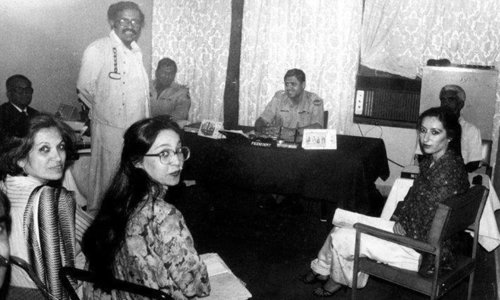
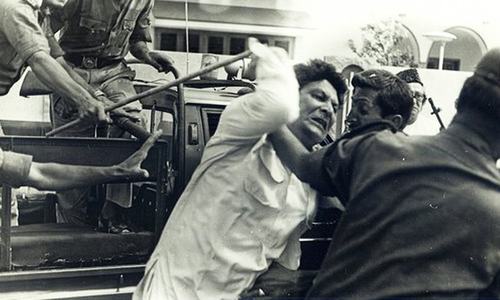
I first met Jam Saqi in 1966. He was a senior student in Sindh University and I had just entered in my first year.
First of all, I was struck by his name. Jam in Urdu is wine and saqi is the one who serves wine.
People used to find his name amusing. He used to explain that Jam was a common first name in Sindh and Saqi was his takhalus — pen name.
Jam Saqi was as unusual a person as his name. He had one pair of shirt and pants. He always wore chappals. I never saw him wearing shoes.
He was always on the move between the old campus of Sindh University in the centre of Hyderabad and various colleges.
Jam was dedication personified. Even before being convinced by his political message, one was convinced of the sincerity of the man.

Soon I started visiting him in the kholi he occupied on the top floor of a shabby building in Tilak Charri. The room was hardly large enough to contain his charpoy.
There was an oil stove in a corner on which he cooked his only meal of the day late in the evening. The meal would generally consist of lentils and chapati. He would always insist that I share the food with him.
Jam was from a small village, Jhanji, in the furthest confines of Tharpakar, only a few kilometres from the Indian border.
His mother tongue was Thari. His father, Sachal Baba, was a teacher in the primary school of the village.
There was a well in the village which yielded only muddy water unless there were sufficient rains.
It was a long distance from Jhanji to Chachro, the nearest town. And travelling from Chachro to Mirpurkhas in those days was like going by train from Karachi to Lahore, to say nothing of Hyderabad, which felt like some light years away.

How did Jam become a communist? When I asked him, he replied that metal is always attracted by magnet.
He was a voracious reader. Apart from Sindhi, he read a lot in Urdu as well as English. One book he liked a lot and gave everyone to read was the Urdu translation of Naked Among Wolves, a novel set in a Nazi-controlled concentration camp.
The Urdu translation, under the title Phool aur Samoom (Flowers and Thorns), was by Razia Sajjad Zaheer, the wife of Sajjad Zaheer, famous Urdu writer and the first general secretary of Communist Party of Pakistan. Jam later on also named his first son Sajjad Zaheer.
A young Sindhi writer of those days, Munir Manik, used to joke that Jam is distributing Phool aur Samosay (Flowers and Samosas) to others all the time.

Jam was an extremely affectionate person. This is what struck the people most in him. He usually embraced everyone on meeting them and his favourite way of addressing them was jani.
This was not merely for form: there indeed was a sincere warmth and gentleness in his attitude towards people irrespective of whether they were political friends or adversaries.
Years later, after spending eight years in jail during the Zia regime, most of it in solitary confinement at the Lahore Fort and Mach Jail, he bore no grudge against the men in uniform.
He used to say that the ordinary soldier has nothing in common with the likes of Yahya Khan and Zia-ul-Haq

Jam was first put in prison in the Ayub era, then under Yahya Khan’s regime and finally during Zia’s time.
Between these stints behind bars, he married his first wife Sukhan, who was from the same village as him.
During his bride’s first visit to Hyderabad, he brought her to meet my mother who had become very fond of him over the years.
My mother was a very religious person but she liked his dedication and simplicity. In the meantime, I went abroad, but he continued to visit my mother.
Later on when Jam had to go underground with the state sleuths at his heels, he used our house to meet with Sukhan.
Just days before he was arrested in 1978, he met his wife in our house. This proved to be his last meeting with Sukhan.

Sukhan had borne him two children, a boy and a girl, Sajjad Zaheer and Bakhtawar. When news spread that Jam was being tortured in Lahore Fort and kept in solitary confinement, Sukhan could not bear it.
To escape the torment, she jumped into the well in her village and died.
Sukhan’s love for Jam would need another Shah Abdul Latif Bhittai to celebrate it in his verses. A Sur Sukhan like Sur Sassi and Sur Marvi.

When Jam came out of jail in 1987, the long imprisonment had taken its toll on him. He was physically diminished. His legs were practically crippled after being kept in a standing position for interrogations lasting hours on end. Sukhan’s death had also wrought grief over his entire existence.
Some years later when well-wishers arranged for his treatment at Cromwell Hospital in London, the doctors told him that it was a miracle that he was still alive. But his lust for life led him to remarry and to re-establish family life.

The ideal Jam fought for suffered a deadly crash with the collapse of the Soviet Union, but his attachment with the poor and oppressed remained intact.
He also had great admiration for those who stood bravely against dictatorial regimes in Pakistan. This was the reason why he held Benazir Bhutto in great esteem
It was not, perhaps, political affiliation as much as adoration for the person who fought empty-handed against the cunning regime of Zia-ul-Haq.

Jam Saqi has died at the age of 74. This was not a short life, but in substance, it was cut short by years of imprisonment and personal sufferings.
When I attended his funeral this week, I was immersed in reminiscence of the days when I first became acquainted with him.
I kept thinking about the man he was and the immense energy he had. He was certainly too great for this life that cuts short the giants.
Have you been part of any landmark moments in Pakistani history? Share your experiences with us at blog@dawn.com