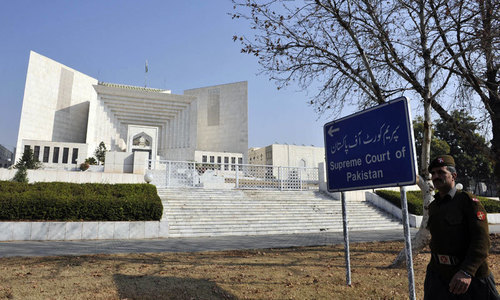
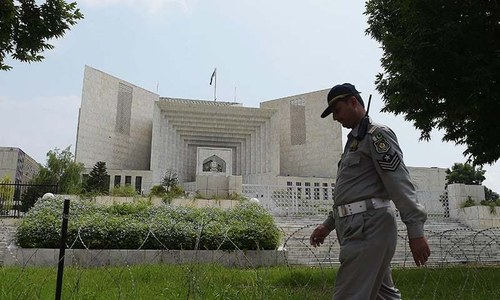
ISLAMABAD: Many were left surprised when during the hearing of a case on Tuesday a Supreme Court judge wondered that the Panama Papers case involved the Sharif family-owned four upscale Avenfield flats in London, but former prime minister Nawaz Sharif was disqualified for holding an iqama (work permit) of the United Arab Emirates (UAE).
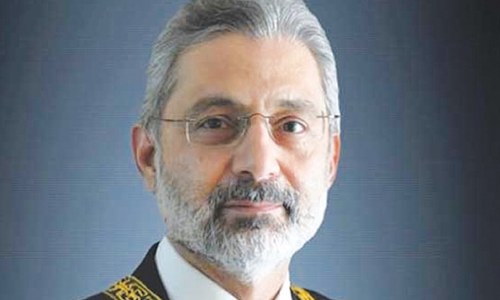
“The Panama Papers case was about London flats, but the judgement came on the iqama,” observed Justice Qazi Faez Isa, who is a member of the three-judge Supreme Court bench which has taken up an appeal of Shakeel Awan, a Pakistan Muslim League-Nawaz (PML-N) member who lost the 2013 elections from Rawalpindi’s NA-55 constituency against Awami Muslim League head Sheikh Rashid Ahmed.
The bench is headed by Justice Sheikh Azmat Saeed.
The court, however, reserved its ruling after hearing both sides.
Justice Qazi Faez Isa says Panama Papers case was about London flats, but judgement came on UAE Iqama
Justice Isa’s observation came when Advocate Sheikh Ilyas, representing Mr Awan, mentioned the last year’s Panama Papers judgement to bolster his arguments against Mr Ahmed.
The apex court disqualified Mr Sharif as member of the National Assembly in the Panama Papers case by invoking Article 62(1)(f) of the Constitution.
The last time the Panama Papers verdict was highlighted was when the Supreme Court heard PML-N leader Hanif Abbasi’s petition in which he sought disqualification of Pakistan Tehreek-i-Insaf chairman Imran Khan and secretary general Jahangir Khan Tareen.
Mr Tareen was eventually disqualified by the apex court.
Advocate Ilyas argued that the case involved concealment of assets by Mr Ahmed who mentioned in his nomination papers for the 2013 general elections that he owned 983 kanals of land although he actually owned 1,081 kanals of land.
Similarly, he said, Mr Ahmed showed the purchase of one kanal of land in the Bahria Gold City for over Rs10 million when the booking price of the land was over Rs48m whereas the current market price of the same land was Rs60m.
The lawyer further said that Mr Ahmed had shown rent of his properties as his source of income in addition to Rs2.2 million profit from his bank accounts. But, he added, his bank statement reflected Rs5.3m from which Rs2.2m profit was not plausible.
He contended that the Representation of Peoples Act, 1976, obligated all intending candidates to disclose their entire assets.
He said the Supreme Court judgement in the Panama Papers case was the latest verdict over the concealment of assets in which Mr Ahmed was also one of the petitioners.
At this, Justice Saeed observed that the court was waiting for the mentioning of the Panama Papers case judgement.
Whether the concept of strict liability had been settled in the Panama Papers case judgement, wondered Justice Isa, saying would not the principles and guidelines laid down in the verdict also apply in other cases.
Justice Saeed, however, asked whether the respondents in the Panama Papers case had ever accepted their mistake.
If the rule of strict liability was to be followed then Mr Ahmed would also stand disqualified, observed Justice Isa, saying that the Panama Papers case judgement did not discuss or had any mention about accepting mistake or error.
“Are you saying that if Mr Ahmed committed a mistake, we should disqualify him following Panama verdict,” the court inquired.
Advocate Abdur Rashid Awan who represented Mr Ahmed, however, disputed that his client had ever concealed any assets, saying that it could be a miscalculation.
He said his client had mentioned all details of his properties, including his agriculture lands, in his nomination papers. But, he added, errors did take place while filing nomination papers.
The Panama Papers case judgement concerned concealment of assets, but in this case his client never concealed any assets, he claimed.
On this Justice Isa observed that the document he was mentioning was never referred to or discussed. He regretted that contesting elections in Pakistan was becoming tougher and difficult day by day and the most difficult aspect was filing of nomination papers.
The judge also referred to a recent statement in which US President Donald Trump had stated that he would never show his income tax returns.
Published in Dawn, March 21st, 2018