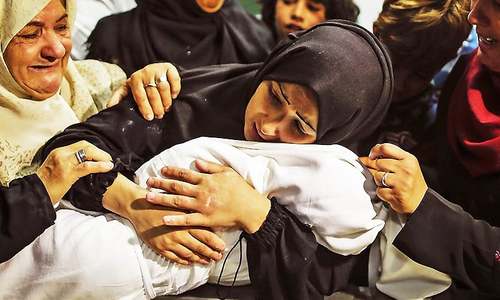
Arab states resoundingly condemned the killing of more than 50 Palestinians in this week’s Gaza protests, just as they have after previous Israeli violence going back decades — but behind the scenes fears over Iran have divided Arab leaders, with some willing to quietly reach out to Israel.
Saudi Arabia, which has used its control of holy sites in Mecca and Medina to brand itself the protector of Islam around the world, offered a brief statement of condemnation and reaffirmed its support for “the Palestinian brotherly people” and their “legitimate rights”.
Over the past year, its powerful Crown Prince Mohammed bin Salman has cultivated close ties with President Donald Trump’s administration. Palestinian officials say Saudi intermediaries have conveyed details of US peace proposals that strongly favor Israel. The administration is said to have been working on a plan for more than a year, but has released no details.
In March, just as the weekly Gaza protests were getting underway, the crown prince met with pro-Israel Jewish American leaders, where he was quoted by Axios, an online newsletter focused on Washington politics, as saying the Palestinians should accept the proposals or “shut up and stop complaining”. The prince later appeared to acknowledge Jewish claims to Israel, telling The Atlantic that Israelis “have the right to have their own land”.
He also suggested that if there is peace, relations between Gulf Arab states and Israel would be of mutual interest.
Read: Silence of Saudi Arabia, other Arab countries over massacre of unarmed Palestinians is disturbing
At a ceremony Monday to mark the relocation of the US Embassy from Tel Aviv to contested Jerusalem — one of the targets of the Gaza protests — Trump’s son-in-law and adviser Jared Kushner said alliances are already shifting in favor of Israel.
“From Israel to Jordan to Egypt to Saudi Arabia and beyond, many leaders are fighting to modernise their countries and create better lives for their people,” Kushner said. “In confronting common threats and in pursuit of common interests, previously unimaginable opportunities and alliances are emerging.”
He spoke as Israeli forces shot and killed at least 59 Palestinians and wounded more than 2,700 during mass protests along the Gaza border.
In pictures: 'Bloodiest day in Israel-Palestine conflict' as US moves embassy to Jerusalem
Kushner has developed a particularly close relationship with the Saudi crown prince, who has used the relationship to build pressure against Iran. The kingdom was one of the few countries to welcome Trump’s withdrawal from the Iran nuclear deal last week.
Warming up to Israel
It isn’t just Saudi Arabia that has inched closer to Israel.
Bahrain’s foreign minister, Khalid bin Ahmed Al Khalifa, tweeted support for Israel after an attack on Iranian targets in Syria last week. The tiny Gulf country, where the Sunni monarchy put down an uprising supported by its Shiite majority in 2011, has long viewed Iran as a threat.
Despite signs of outreach with Israel and a shared enmity for Iran, Bahrain condemned the targeting of Palestinian civilians on Monday, and reaffirmed support for an independent Palestinian state with east Jerusalem as its capital. The United Arab Emirates also condemned Israel’s “current escalation in the Gaza Strip”.
State-aligned media took a tougher line. A front-page editorial Tuesday in Dubai’s Gulf News ran with the headline: “Mr. President, you killed any glimmer of hope for peace.” The front page of Abu Dhabi’s The National described the US Embassy move as “a new catastrophe”.
Tough rhetoric aside, Israeli businessmen are known to work in the UAE, often traveling in on American or European passports. The UAE hosts an Israeli representative to the Abu Dhabi-based International Renewable Energy Agency, while Israeli judo stars spar in annual competitions in the Emirati capital. Bicyclists sponsored by the UAE and Bahrain recently took part in the Giro d ’Italia race leg held in Israel.
Related: Dinner diplomacy: Netanyahu’s unusual run-in with UAE envoy
Among Arab Gulf states, Qatar’s statement was the most fiercely-worded. It described the violence as a “brutal massacre and systematic killing committed by the Israeli occupation forces against unarmed Palestinians in the Gaza Strip, including children and women, during their peaceful and legitimate protest.”
Qatar’s leaders have spent millions of dollars on rebuilding the Gaza Strip and, in coordination with Israel, supplying humanitarian aid there. Qatar has also hosted Hamas leaders over the years.
But even as it has provided aid to the Palestinians, Qatar has welcomed prominent pro-Israel figures from the US over the past year for conversations with the ruling emir. Harvard law professor Alan Dershowitz was among those invited, later writing that his visit to Qatar was paid for by the emir and commending Qatar for welcoming Israeli athletes to tournaments there.
Qatar’s outreach appears to be driven by an effort to maneuver politically in the face of a nearly year-long blockade by Egypt, Saudi Arabia, the UAE and Bahrain. The standoff was ignited in part by Qatar’s support of Islamist groups, such as Hamas, which rules the Gaza Strip and has fought three wars against Israel. The other Arab states are also angered by Qatar’s warm relations with Iran.
Egypt, which once led the Arab struggle against Israel and fought several wars against it, became the first Arab nation to make peace in 1978. But the peace was always cold, with ordinary Egyptians enforcing a cultural boycott of Israel and regularly holding mass rallies in support of the Palestinians.
In recent years, however, Egypt has found common cause with Israel in containing Hamas and combatting Islamic extremists in the Sinai Peninsula. Egypt helps maintain the Israeli blockade of Gaza by only rarely opening its Rafah border crossing. Meanwhile, the Islamist and leftist activists who once organized demonstrations are nearly all in jail or exile, amid a sweeping crackdown on dissent.
In a sign of improved ties with Israel, the Israeli Embassy in Cairo celebrated the 70th anniversary of the country’s founding earlier this month at the Nile Ritz Carlton. Only seven years earlier, protesters in Cairo had ransacked the Israeli embassy, climbing up the high-rise tower overlooking the Nile and tearing down the Israeli flag.